






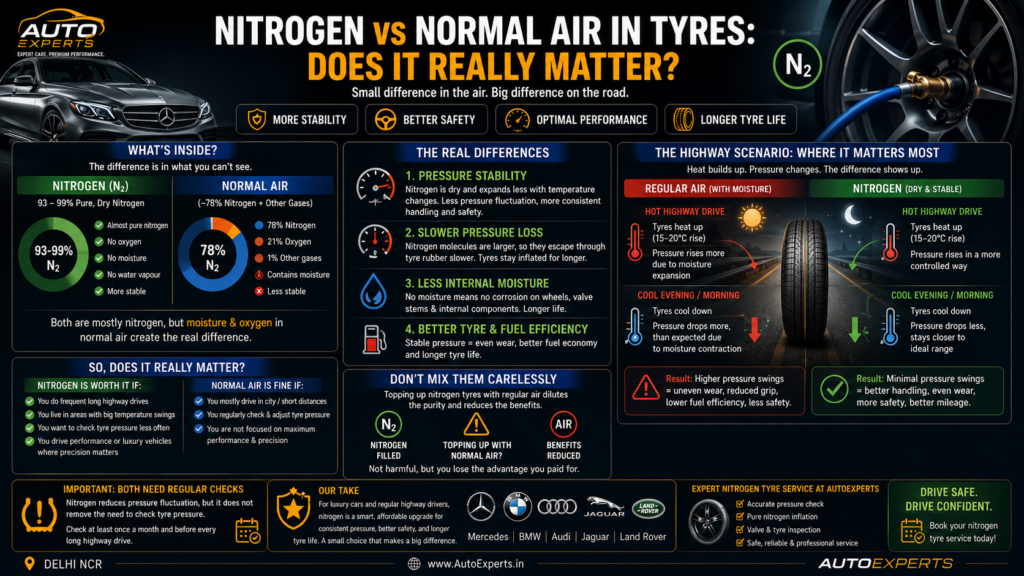
Nitrogen vs Normal Air in Tyres: Does It Really Matter?
Pull into most tyre shops today and you’ll be offered a choice: top up with regular air, or pay a bit extra for nitrogen. For a lot of owners, it’s not clear whether that extra cost buys real protection or just a marketing upsell. The honest answer sits somewhere in between — nitrogen offers genuine, measurable benefits, but whether they matter to you depends on how and where you drive.
Here’s what’s actually different, including a scenario every highway driver should understand: how temperature swings affect tyre pressure differently depending on what’s inside the tyre.
What’s Actually in “Normal Air” vs Nitrogen
The air from a standard air compressor is roughly 78% nitrogen already — it’s mostly nitrogen to begin with. The difference is the rest: regular air also contains oxygen, moisture, and trace gases, while tyre shops offering “nitrogen fill” use tanks of 93-99% pure, dry nitrogen with the oxygen and moisture removed.
That moisture content is the detail that matters most, and it’s the root of almost every practical difference between the two.
The Real Differences
1. Pressure Stability Across Temperature Changes
This is the single biggest practical advantage of nitrogen, and it comes down to basic gas behavior: nitrogen molecules are slightly larger and don’t expand and contract with temperature changes as sharply as oxygen and, especially, the water vapor present in regular air.
Moisture inside a tyre is the real culprit — water vapor expands and contracts far more dramatically with temperature than dry gas does, which means a tyre filled with regular (humid) air will show more pressure swings between a cold morning and a hot afternoon than one filled with dry nitrogen.
2. Slower Pressure Loss Over Time
Nitrogen molecules are larger than oxygen molecules, which means they escape through the microscopic pores in tyre rubber more slowly. Tyres filled with nitrogen tend to hold pressure for longer stretches without needing a top-up, compared to regular air, which permeates out a bit faster.
What this means: Less frequent pressure checks needed, and more consistent pressure over weeks between top-ups — though it doesn’t eliminate the need to check pressure altogether.
3. Less Internal Moisture, Less Internal Rust
Regular air introduces moisture into the tyre and onto the inside of the wheel. Over years, that moisture can contribute to minor corrosion on steel wheels or on the valve stem components, and repeated humidity fluctuation inside the tyre cavity is part of what fuels the pressure instability described above.
What this means: Nitrogen’s dry composition avoids introducing that moisture in the first place, which is a modest but real long-term benefit, particularly relevant in a humid climate.
The Highway Scenario: Where This Becomes Real
Here’s where the difference stops being theoretical and starts affecting how your car actually handles.
On a long highway stretch, tyres heat up significantly from friction and sustained speed — often 15-20°C hotter than they started, sometimes more on a hot day. As the tyre heats, the gas inside expands, and pressure rises. This is normal and expected with either gas.
The problem shows up with regular air specifically because of that moisture content. Humid air doesn’t expand as predictably as dry nitrogen — water vapor inside the tyre behaves more erratically as it heats and cools, causing pressure to swing more sharply than the temperature change alone would suggest. On a hot highway drive, this can mean a bigger-than-expected pressure spike; later, once you’ve stopped and the tyre cools back down — especially if it’s evening, or if you hit a sudden climate shift like rain or a temperature drop — that same moisture-driven instability causes pressure to fall more than it would with dry nitrogen, sometimes leaving the tyre under-inflated by the next morning.
Why this matters practically: Under-inflated tyres from this kind of swing increase rolling resistance, reduce fuel efficiency, wear the tyre edges faster, and — most importantly on a highway — reduce grip and handling precision exactly when you’re driving at higher speeds. Over-inflated tyres from the heat spike, on the other hand, reduce the tyre’s contact patch and can make the ride harsher and less predictable through corners.
Nitrogen doesn’t eliminate this heat-related pressure change entirely — gas still expands with heat regardless of composition — but because it’s dry, the swings are smaller and more predictable, which means the tyre’s behavior stays closer to what you set it up for, even after a long, hot highway stretch followed by a cooler evening.
So Does It Really Matter?
Nitrogen is genuinely worth it if:
- You do frequent long highway drives, where heat cycling is significant
- You live somewhere with large day-to-night or seasonal temperature swings
- You want to check and adjust tyre pressure less often
- You’re running performance tyres where precise, consistent pressure meaningfully affects handling
Regular air is perfectly fine if:
- You mostly drive in the city with shorter trips and less heat buildup
- You’re comfortable checking and adjusting tyre pressure regularly (which you should be doing either way)
- You’re not chasing the last small percentage of handling precision
The honest caveat: Nitrogen is a genuine improvement, not a magic fix. It reduces pressure fluctuation — it doesn’t eliminate the need to monitor tyre pressure altogether. Whichever gas is in your tyres, pressure should still be checked at least monthly and before any long highway trip.
One Practical Note: Don’t Mix Them Carelessly
If your tyres are already filled with nitrogen and you top them up with regular air at a random pump because that’s what’s available, you dilute the nitrogen concentration and lose most of the stability benefit anyway. It’s not harmful to the tyre, but it does mean you’re no longer getting what you paid for. If you’ve committed to nitrogen, it’s worth topping up at a nitrogen-equipped station when possible, or being aware that a regular-air top-up resets some of that advantage.
Our Take
For a luxury vehicle doing regular highway driving — which describes a large share of Mercedes, Audi, and BMW owners — nitrogen is a worthwhile, relatively inexpensive upgrade that keeps tyre pressure more consistent through exactly the kind of heat cycling that highway driving produces. It’s not a dramatic transformation, but it’s a small, sensible edge in both handling consistency and tyre longevity.
Ask us about a nitrogen tyre service at your next visit — we’ll check your current pressure, top you up correctly, and make sure your tyres are set up to handle whatever the next long drive throws at them.