



Autoexperts

Uncategorized

Infographic explaining common causes of heavy steering, including low power steering fluid, EPS motor faults, tyre pressure, wheel alignment, hydraulic pump issues, and steering diagnostics for Mercedes-Benz, BMW, Audi, Jaguar, and Land Rover.

Why Your Steering Feels Heavy: Common Reasons Explained

Why Your Steering Feels Heavy: Common Reasons Explained Power steering is one of those systems you only really notice when it stops working the way it should. A steering wheel that suddenly feels heavier — harder to turn at low speed, more effort needed in parking lots, less responsive on the highway — is a clear signal that something in the system isn’t performing correctly, even if the car otherwise drives normally. Here’s what’s usually behind it, and what actually needs attention depending on the cause. First, What Kind of Steering System Does Your Car Have? This matters because the likely causes differ: Knowing which system your car uses narrows down the likely cause considerably, so if you’re not sure, it’s worth checking your owner’s manual or asking your service advisor. Common Causes on Hydraulic Power Steering Systems 1. Low or Leaking Power Steering Fluid This is the most common cause on hydraulic systems, and often the easiest to catch early — a slow leak from a hose, seal, or the pump itself gradually reduces fluid level, and with it, the system’s ability to assist steering effort. How to tell: Check the power steering fluid reservoir level, and look for any fluid spots under the front of the car, typically a reddish or amber color. A whining noise when turning the wheel, especially at low speed, often accompanies low fluid. The fix: A slow leak is usually a straightforward seal or hose repair when caught early. Simply topping up fluid without finding the leak is a short-term fix — it’ll drop again, and continuing to drive with very low fluid can damage the power steering pump itself, turning a modest repair into a considerably more expensive one. 2. Worn or Slipping Power Steering Belt On hydraulic systems, the power steering pump is typically driven by a belt connected to the engine. A worn, glazed, or slipping belt reduces how effectively the pump can build pressure. How to tell: Steering that feels heavy specifically at low RPM or idle, sometimes paired with a squealing noise on startup or during hard turns, points toward belt slippage. The fix: Belt inspection and replacement is a routine, inexpensive service — worth checking at scheduled intervals, since a belt showing early wear is easy to replace proactively before it fails. 3. Failing Power Steering Pump If fluid levels are fine and the belt is in good condition, but steering still feels heavy or inconsistent, the pump itself may be wearing out internally. How to tell: A whining or groaning noise that changes with steering angle, along with steering effort that feels inconsistent rather than uniformly heavy, often points to the pump. The fix: Pump replacement is a more involved repair than a fluid top-up or belt change, which is exactly why catching fluid leaks and belt wear early matters — both are common contributors to premature pump failure. Common Causes on Electric Power Steering (EPS) Systems 4. EPS Motor or Sensor Fault Electric power steering relies on a torque sensor and electric motor working together, managed by a control module. A fault in any of these components can reduce or eliminate steering assist. How to tell: Heavy steering on an EPS-equipped car is often paired with a dashboard warning light (commonly a steering wheel icon or “check power steering” message), since the system actively monitors itself. The fix: This requires a proper diagnostic scan to identify which component is at fault — the sensor, the motor, or the control module — since guessing at replacement parts on an EPS system can be costly if the wrong component is swapped. 5. Software or Calibration Issues EPS systems are software-managed, and occasionally a calibration drift or an outdated software version can cause the steering assist to feel inconsistent or heavier than expected, even without a hardware fault. How to tell: This is harder to self-diagnose, since it doesn’t always trigger an obvious warning light — inconsistent assist that doesn’t match any of the other causes on this list is worth raising with a technician who can check for pending software updates. The fix: A software recalibration or update, done through brand-specific diagnostic tools, can resolve this without any parts replacement at all — one of the few causes on this list that’s a pure software fix. Causes That Apply to Both Systems 6. Low or Uneven Tyre Pressure This is one of the simplest, most overlooked causes. Under-inflated tyres increase the contact patch and rolling resistance, which makes the steering feel noticeably heavier, particularly at low speeds like parking maneuvers. How to tell: Check tyre pressure against the manufacturer-recommended figure (usually on a sticker inside the driver’s door). Heavy steering that’s specifically worse at parking-lot speeds and normal on the highway often points here first, since it’s the quickest thing to rule out. The fix: Adjust pressure to spec. If this resolves the heaviness, no further diagnosis is needed — though it’s worth checking why the pressure was off (a slow leak versus simply overdue for a check). 7. Wheel Alignment or Suspension Issues Misalignment or worn suspension components change the geometry the steering system is working against, which can make the wheel feel heavier, pull to one side, or feel inconsistent through turns. How to tell: Heavy steering paired with the car pulling to one side, uneven tyre wear, or a vibration through the wheel points toward alignment or suspension rather than the power steering system itself. The fix: A wheel alignment check is a quick, inexpensive diagnostic step, and often resolves the issue directly if that’s the cause. If suspension components are worn, that’s a separate repair, but one worth catching early since it also affects tyre wear and handling. 8. Cold Weather Stiffness In colder conditions, power steering fluid (on hydraulic systems) can thicken slightly, and even EPS systems can feel marginally stiffer in the first few minutes after a cold start. How to tell: Heaviness that’s specifically worse right after starting the

Why Your Steering Feels Heavy: Common Reasons Explained Read More »

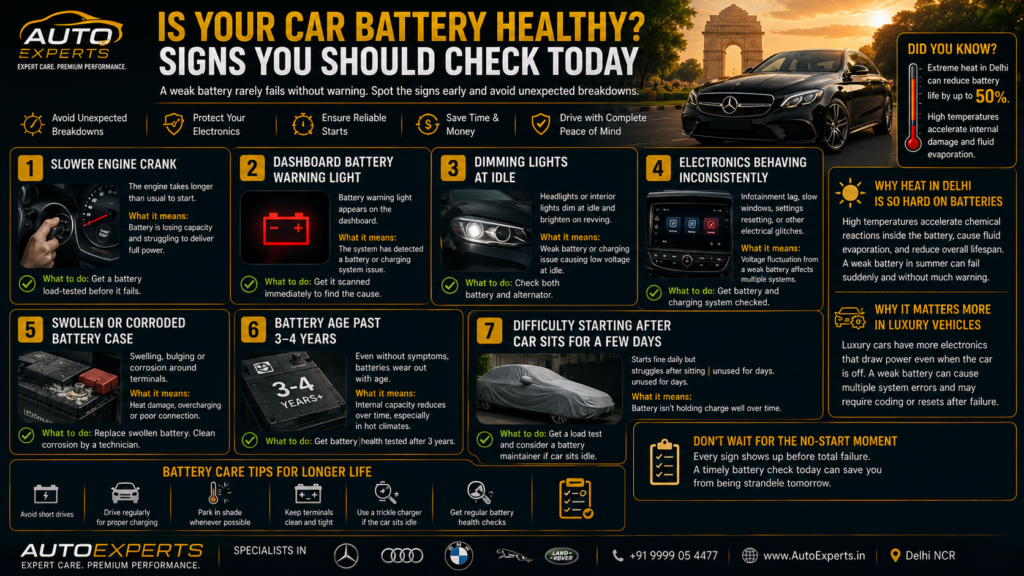
Infographic explaining the warning signs of a weak car battery, including slow engine cranking, battery warning light, dim headlights, electrical issues, battery corrosion, ageing battery, and difficulty starting for Mercedes-Benz, BMW, Audi, Jaguar, and Land Rover.

Is Your Car Battery Healthy? 7 Signs You Should Check Today

Is Your Car Battery Healthy? Signs You Should Check Today A dead battery has a way of announcing itself at the worst possible moment — a Monday morning meeting, a highway trip you’re already running late for, a hot afternoon with the AC on full blast. What makes it frustrating is that batteries rarely fail without warning. They usually give off subtle signs for weeks, sometimes months, before finally giving out — most owners just don’t know what to look for until it’s too late. Here’s what your battery is actually telling you, and when those signs mean it’s time for a check rather than a wait-and-see approach. 1. Slower Engine Crank This is usually the earliest and most reliable sign. If turning the key or pressing start results in the engine cranking noticeably slower than usual — a bit of hesitation before it catches — that’s the battery struggling to deliver full power to the starter motor. What it means: A battery losing capacity can still start the car for a while, just with less margin each time. This is the stage where a check makes the biggest difference, since the battery hasn’t failed yet — it’s just weakening. What to do: Get the battery load-tested rather than waiting for it to fully die. A load test measures actual capacity under demand, which tells you definitively whether it’s a battery issue or something else, like a starter motor problem. 2. Dashboard Battery Warning Light Modern Mercedes, Audi, and BMW models monitor battery health and charging system performance continuously, and a battery warning light appearing is a direct signal that the system has detected a real issue — either with the battery itself or the alternator’s ability to charge it. What it means: This light isn’t something to drive around for a few days assuming it’ll resolve itself. It’s the car’s electrical system flagging a specific, detected problem. What to do: Get it scanned as soon as possible. The diagnostic will tell you whether it’s the battery, the alternator, or a charging system fault — each requires a different fix, and driving on a failing charging system can leave you stranded with very little warning. 3. Dimming Headlights or Interior Lights at Idle If your headlights or interior lights seem to dim slightly when the engine is idling — particularly if they brighten again when you rev the engine — that’s a sign the electrical system isn’t getting consistent power at low RPM, often pointing to a weakening battery or charging issue. What it means: At idle, the alternator produces less charging power, so if the battery isn’t holding a strong charge on its own, the electrical system has less to draw from, and lights are often the most visible symptom. What to do: This is worth a battery and alternator check together, since the symptom overlaps between the two — a technician can isolate which one is actually the cause. 4. Electronics Behaving Inconsistently Luxury vehicles run a lot of electronics — infotainment systems, power windows, seat memory functions, climate control — all of which depend on stable voltage. A weakening battery can cause these systems to behave oddly: a slow-responding infotainment screen, windows that move sluggishly, or settings that occasionally reset. What it means: These systems are sensitive to voltage fluctuation, and inconsistent behavior across multiple electronics at once is a more telling sign than any single glitch on its own. What to do: If you notice several small electrical quirks appearing around the same time, rather than troubleshooting each one separately, have the battery and charging system checked as the likely common cause. 5. A Swollen or Corroded Battery Case This one’s visible if you actually look — pop the hood and check the battery case for any bulging, swelling, or a white/greenish crusty buildup around the terminals. What it means: A swollen case usually indicates the battery has been exposed to excessive heat or has been overcharged, both of which damage the internal cells. Corrosion at the terminals restricts the electrical connection, which can mimic the symptoms of a weak battery even if the battery itself is otherwise fine. What to do: A swollen battery should be replaced — this isn’t a repair situation, it’s a safety one, since a damaged case can leak or, in rare cases, rupture. Corrosion, on the other hand, can often be cleaned by a technician, which alone sometimes resolves what looked like a battery problem. 6. Battery Age Past 3-4 Years Even a battery showing no symptoms at all is worth checking proactively once it crosses the 3-4 year mark, which is the general lifespan for most standard car batteries under normal conditions — shorter in consistently hot climates like Delhi, where heat accelerates internal degradation. What it means: Batteries don’t always decline gradually and predictably — some hold a reasonably strong charge until fairly close to failure, then drop off quickly. Age alone is a legitimate reason to test, even without other symptoms present. What to do: Have battery health tested as part of routine servicing once it’s past the 3-year mark, rather than waiting for a symptom to prompt the check. 7. Difficulty Starting After the Car Sits for a Few Days If your car starts fine when driven daily but struggles after sitting unused for a few days — a weekend car, a second vehicle, or simply a few days without use — that’s a sign the battery isn’t holding charge well over time, even if it seems fine during regular use. What it means: A healthy battery should hold a charge for well over a week of inactivity under normal conditions. Struggling after just a few days points to reduced capacity, even if daily starts still feel normal. What to do: If this happens more than once, it’s worth a load test rather than assuming it’s a one-off. For vehicles that sit unused often, a trickle charger or battery maintainer can also help extend battery

Is Your Car Battery Healthy? 7 Signs You Should Check Today Read More »

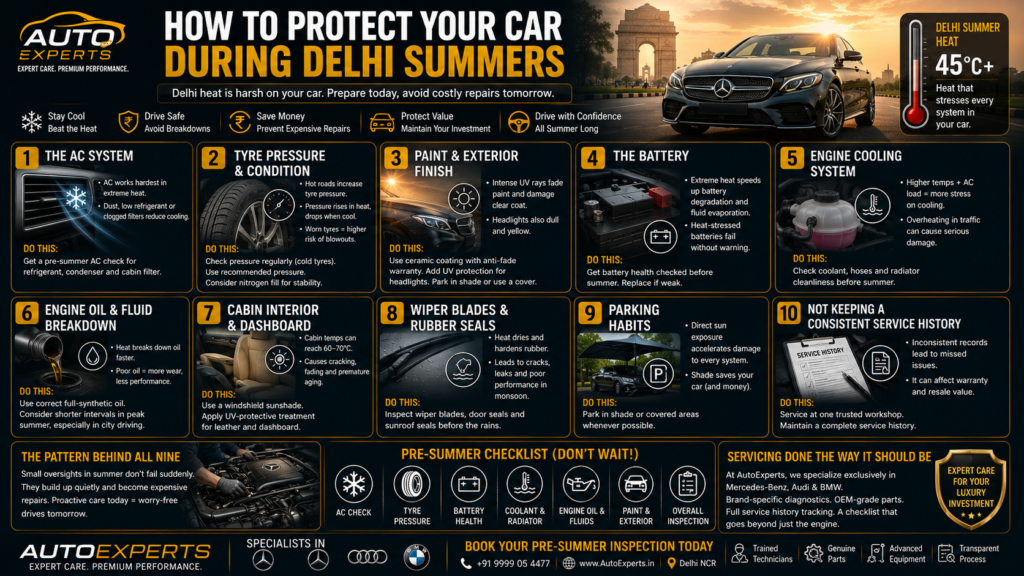
Infographic explaining how to protect your car during Delhi summers, covering AC maintenance, tyre pressure, battery care, paint protection, engine cooling, engine oil, dashboard care, parking tips, and summer inspections for Mercedes-Benz, BMW, Audi, Jaguar, and Land Rover.

How to Protect Your Car During Delhi Summers: The Complete Summer Care Guide

How to Protect Your Car During Delhi Summers Delhi summers don’t ease in gradually — by April, temperatures are already pushing past 40°C, and by June, the tarmac itself becomes a heat source, radiating warmth back up into the car long after the sun has technically moved on. For a luxury vehicle, this isn’t just uncomfortable, it’s a genuine stress test across nearly every system: the AC, the tyres, the paint, the battery, and the cabin all take a harder hit than they would in a milder climate. Here’s a system-by-system look at what Delhi’s summer actually does to your car, and what you can do about each one before the heat catches you off guard. 1. The AC System Delhi’s heat pushes AC systems to their absolute limit, and any existing weakness — low refrigerant, a dusty condenser, a clogged filter — that felt unnoticeable in winter becomes obvious the moment summer arrives. What to do: Get a pre-summer AC health check that covers refrigerant levels, condenser cleanliness, and cabin filter condition — ideally before peak heat hits, not after you’re already sitting in a warm car during a traffic jam. If your AC felt sufficient a few months ago and feels weaker now, that’s a sign of an underlying issue, not just “the heat.” 2. Tyre Pressure and Condition Hot tarmac and sustained highway speeds cause tyres to heat up significantly, and the air inside expands as a result. Combined with Delhi’s daytime heat baking the tyre from outside as well, pressure can rise well above your usual setting during a summer drive — and drop again once temperatures fall in the evening. What to do: Check tyre pressure more frequently in summer than you would the rest of the year, ideally when tyres are cool (first thing in the morning, before driving). Avoid over-inflating to compensate for expected heat gain — set to the manufacturer-specified cold pressure and let the heat do the rest. If you haven’t already, nitrogen fill helps reduce the size of these swings, since it’s less affected by heat-driven expansion than regular air. 3. Paint and Exterior Finish UV exposure in Delhi summers is intense and sustained, and it’s the single biggest factor behind paint fading, dulling, and clear coat degradation over time. Headlights take a similar hit, since their protective UV coating breaks down under the same conditions. What to do: A ceramic coating with a proper anti-fade guarantee is the most direct way to protect paint through summer, and it’s worth extending that same UV protection to your headlights specifically, since they’re often left out even when the paint is coated. Parking in shade or using a car cover during peak hours also meaningfully slows this degradation over the season. 4. The Battery It’s a common misconception that batteries only struggle in cold weather — in reality, extreme heat is harder on a car battery than cold, because high temperatures accelerate the internal chemical reactions that cause a battery to degrade, and speed up fluid evaporation inside it. What to do: Have your battery’s health checked before summer rather than waiting for it to fail — batteries often show reduced capacity gradually before they fail outright, and a heat-stressed battery is more likely to give out with little warning, often at the worst possible moment (like a hot afternoon with the AC running at full load). 5. Engine Cooling System Between higher ambient temperatures and increased AC load, your engine’s cooling system works considerably harder through a Delhi summer than the rest of the year, especially during long idling in traffic when there’s little airflow to help. What to do: Have coolant levels, hose condition, and radiator cleanliness checked before summer — a coolant that’s overdue or a radiator partially clogged with road dust and debris reduces cooling efficiency exactly when the system needs it most. If you notice the temperature gauge running higher than usual, especially in traffic, don’t wait for the next scheduled service to have it looked at. 6. Engine Oil and Fluid Breakdown Heat accelerates oil breakdown, and Delhi’s summer combination of high ambient temperature, traffic idling, and AC load means oil works harder and degrades faster than it would in milder months. What to do: If your driving is mostly summer city traffic, consider shifting to the shorter end of your service interval during peak heat months, and make sure you’re using the correct full-synthetic spec for your engine — a lower-grade oil is even more likely to break down prematurely under Delhi’s summer conditions. 7. Cabin Interior and Dashboard Prolonged heat and UV exposure inside a parked car — which in Delhi summer can easily reach 60-70°C inside a closed cabin — takes a toll on leather, dashboard materials, and interior trim over time, causing cracking, fading, and premature aging of surfaces. What to do: Use a windshield sunshade when parking outdoors for extended periods, and consider a UV-protective treatment for leather seats and dashboard surfaces. Cracking windshield sunshade use also has a practical side benefit: it keeps the cabin meaningfully cooler, reducing the initial load on your AC when you start driving. 8. Wiper Blades and Rubber Seals It’s easy to forget wiper blades in summer since they’re associated with monsoon use, but constant heat exposure dries out and hardens rubber components — wiper blades, door seals, and sunroof seals — even when they’re not being actively used. What to do: Inspect wiper blades and rubber seals before monsoon season arrives (which follows shortly after peak summer in Delhi). A seal that’s hardened from months of summer heat is exactly the kind of thing that fails to keep water out once the rains start. 9. Parking Habits Where and how you park during summer has a bigger cumulative effect than most owners realize — direct sun exposure for hours daily accelerates nearly every issue on this list, from paint fading to battery stress to interior cracking. What to do: Prioritize shaded or covered

How to Protect Your Car During Delhi Summers: The Complete Summer Care Guide Read More »

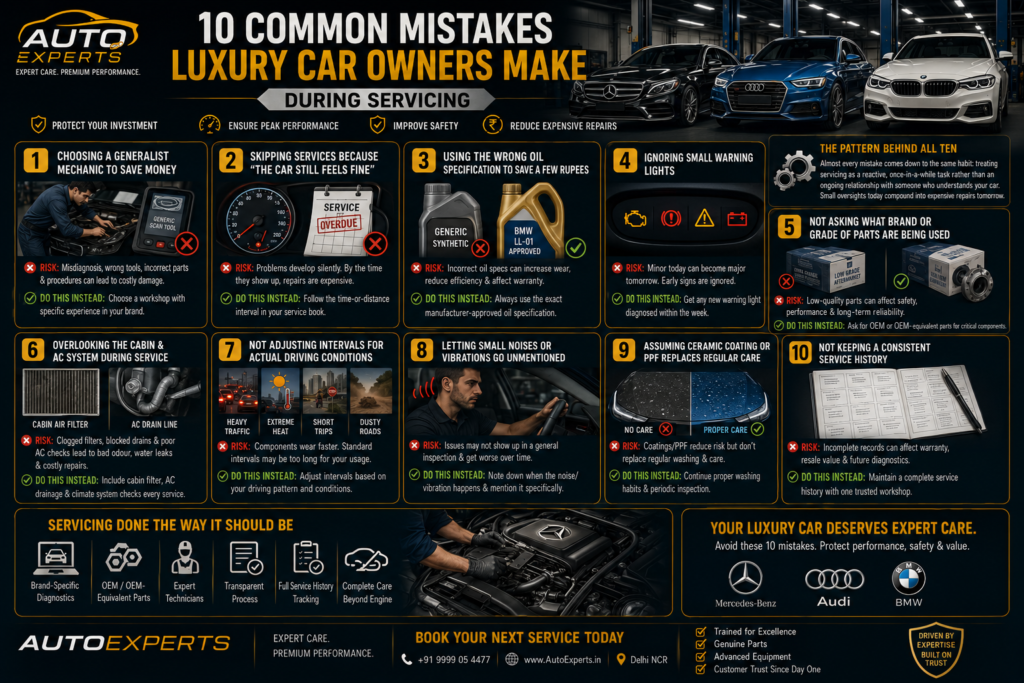
Infographic showing the 10 most common servicing mistakes luxury car owners make, including skipped maintenance, incorrect engine oil, ignored warning lights, poor-quality parts, and inconsistent service history for Mercedes-Benz, BMW, Audi, Jaguar, and Land Rover.

10 Common Mistakes Luxury Car Owners Make During Servicing

10 Common Mistakes Luxury Car Owners Make During Servicing Owning a Mercedes-Benz, Audi, or BMW comes with a certain assumption: that the car, being premium, will simply hold up well with minimal thought. In practice, the opposite is closer to true — these vehicles reward proactive, informed maintenance and are less forgiving of shortcuts than a mainstream car might be. Most of the expensive repairs we see didn’t start as sudden failures. They started as small, avoidable decisions made during routine servicing. Here are the ten mistakes we see most often — and what to do instead. 1. Choosing a Generalist Mechanic to Save Money It’s a reasonable instinct: a generalist workshop often quotes less than a brand-specialist one. But luxury vehicles use proprietary diagnostic software, brand-specific torque specs, and components that don’t always behave like their mainstream equivalents. The risk: A generalist mechanic might misread a fault code that’s normal for a Mercedes or BMW but would signal a real problem on another brand, or use a generic part that doesn’t match the engineering tolerance the car was built around. Do this instead: Use a workshop with specific experience on your brand, even if the upfront cost is slightly higher. The cost of a misdiagnosis is almost always greater than the savings from a cheaper shop. 2. Skipping Services Because “The Car Still Feels Fine” This is the single most common mistake, and it comes from a fair assumption — if nothing feels wrong, why spend money? The problem is that scheduled maintenance exists precisely to catch things before they feel wrong. The risk: Oil degrades, brake pads thin, and fluids age on a timeline that has nothing to do with how the car feels to drive. By the time a problem is noticeable, it’s often already progressed past the cheap-fix stage. Do this instead: Follow the time-or-distance interval in your service book, whichever comes first — not how the car feels on a given day. 3. Using the Wrong Oil Specification to Save a Few Rupees Not all “synthetic” oil is the same. Manufacturers specify exact approved specifications (like BMW LL-01 or Mercedes MB 229.5) that are engineered around how that specific engine runs — its turbo, its tolerances, its emissions system. The risk: A cheaper synthetic that doesn’t meet the exact spec can still cause increased wear over time, and in some cases, using an unapproved oil can affect warranty claims if an engine issue arises later. Do this instead: Always confirm the exact spec required for your model — not just “synthetic” as a general category — and make sure it’s what’s actually being used at every service. 4. Ignoring Small Warning Lights Because “It’s Probably Nothing” A dashboard light that stays on gets mentally filed away as background noise after a while, especially if the car still drives normally. The risk: Warning lights exist because a sensor detected something outside normal range — sometimes minor, sometimes an early sign of a bigger issue. Driving with it ignored for months means losing the early-detection advantage the system was designed to give you. Do this instead: Get any new warning light diagnosed within the week, even if the car seems to be driving fine. A diagnostic scan is quick and tells you definitively whether it’s minor or worth addressing now. 5. Not Asking What Brand or Grade of Parts Are Being Used It’s easy to assume “genuine parts” are automatically being used at every service, especially at a shop that specializes in luxury brands. That’s not always the case unless it’s specifically confirmed. The risk: Aftermarket parts vary hugely in quality. Some match OEM standards closely; others don’t, and using a lower-grade part in a critical system — brakes, suspension, filtration — can affect both performance and longevity. Do this instead: Ask directly what parts are being used for any given repair, and request OEM or OEM-equivalent parts for anything safety-critical or performance-relevant. 6. Overlooking the Cabin and AC System During Service Engine-related maintenance tends to get all the attention, while cabin air filters, AC drainage, and climate system checks get treated as optional extras. The risk: A clogged cabin filter or blocked AC drain doesn’t just reduce comfort — it can strain the blower motor, cause musty odors, or in worse cases, lead to water pooling inside the cabin from a blocked drain line. Do this instead: Make sure cabin filters, AC drainage, and climate system performance are part of your standard service checklist, not something you have to remember to ask about separately. 7. Not Adjusting Service Intervals for Actual Driving Conditions Manufacturer service intervals assume “average” driving conditions. Heavy traffic, extreme heat, frequent short trips, or dusty roads all count as more demanding than average — but most owners stick to the standard interval regardless. The risk: A car driven mostly in stop-and-go city traffic or extreme heat wears components faster than the standard interval accounts for, meaning sticking rigidly to “12 months or 15,000 km” can mean servicing later than the car actually needs. Do this instead: Talk to your service advisor about your actual driving pattern and adjust intervals accordingly — particularly oil changes, filters, and brake inspections. 8. Letting Small Noises or Vibrations Go Unmentioned Owners often notice a faint new noise or vibration, decide it’s minor, and simply forget to mention it at the next service, assuming the technician will catch it during inspection. The risk: A general inspection doesn’t always reproduce every driving condition where a specific noise occurs — a rattle at a certain speed, a vibration during braking, a click only under acceleration. Technicians rely on owner input to know exactly where to focus. Do this instead: Keep a simple note on your phone of anything unusual you notice between services — when it happens, at what speed, under what conditions — and mention it specifically rather than assuming it’ll be caught automatically. 9. Assuming Ceramic Coating or PPF Replaces Regular Washing and Care Paint protection

10 Common Mistakes Luxury Car Owners Make During Servicing Read More »

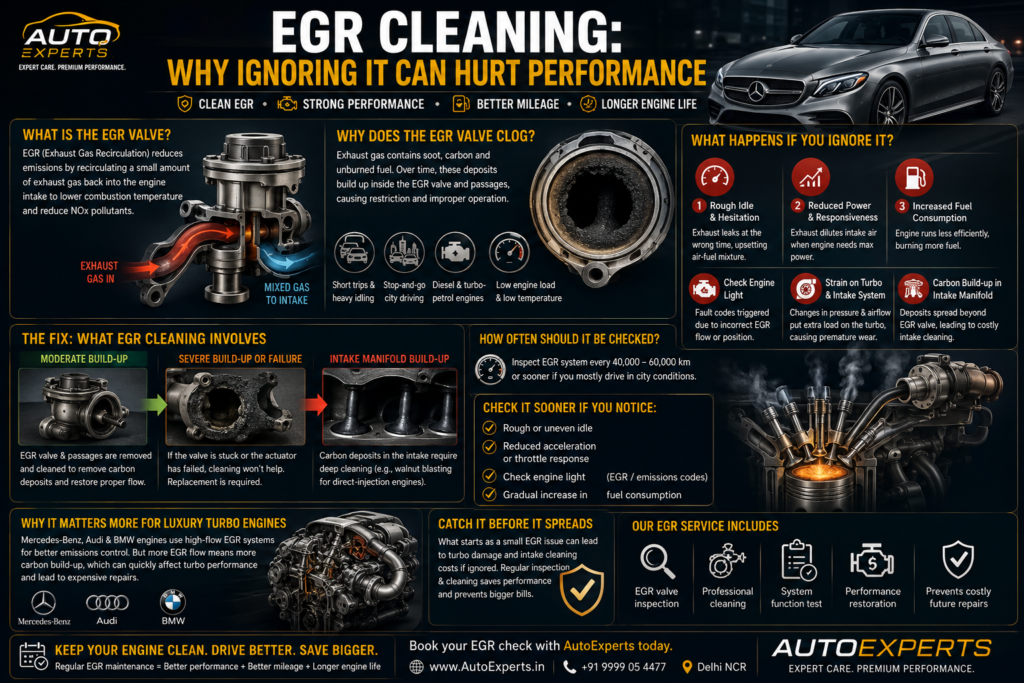
Infographic explaining EGR cleaning, carbon build-up, rough idle, reduced performance, turbo strain, and EGR valve maintenance for Mercedes-Benz, BMW, Audi, Jaguar, and Land Rover.

EGR Cleaning: Why Ignoring It Can Hurt Performance

EGR Cleaning: Why Ignoring It Can Hurt Performance Ask most car owners what an EGR valve does, and you’ll get a blank look — it’s one of those components that quietly does its job for years until it doesn’t, and by then the symptoms (rough idle, reduced power, a stubborn check engine light) rarely point directly to the actual cause. That disconnect is exactly why EGR maintenance gets skipped more than almost anything else on a service checklist. Here’s what the EGR valve actually does, why it clogs, and why letting it go too long costs you more than just performance. What the EGR Valve Actually Does EGR stands for Exhaust Gas Recirculation. Its job is to take a small, controlled portion of exhaust gas and route it back into the engine’s intake, mixing it with the incoming air-fuel charge. This might sound counterintuitive — why put exhaust back into the engine? The answer is emissions control: recirculating some exhaust gas lowers the peak combustion temperature inside the cylinders, which significantly reduces the formation of nitrogen oxides (NOx), a major pollutant. It’s a core part of how modern engines meet emissions standards without sacrificing too much performance. The valve itself opens and closes based on engine load and speed, managed by the engine control unit, to let exactly the right amount of exhaust gas back in at the right time. Why It Clogs The exhaust gas being recirculated isn’t clean — it carries soot, carbon particles, and unburned fuel residue, especially in diesel and modern turbo-petrol engines. Every time that gas passes through the EGR valve and its passages, a small amount of this residue deposits on the surfaces it touches. Over time, this builds into a hard, carbon-like buildup that narrows the valve’s passages and can eventually prevent it from opening and closing fully. What makes it worse: What Happens When You Ignore It 1. Rough Idle and Hesitation A partially stuck or clogged EGR valve often gets stuck slightly open or fails to close fully, letting exhaust gas leak into the intake when the engine doesn’t need it — at idle or during light acceleration, for example. This throws off the precise air-fuel mixture the engine is expecting, leading to a rough, uneven idle or a hesitation when you press the accelerator. 2. Reduced Power and Responsiveness When the EGR valve doesn’t close properly during acceleration, exhaust gas dilutes the air-fuel charge exactly when the engine needs maximum clean air for power. This shows up as sluggish acceleration or a noticeable dip in responsiveness — often mistaken for a general “the car feels older” issue rather than a specific, fixable cause. 3. Increased Fuel Consumption An engine compensating for an improperly functioning EGR system often runs a less efficient combustion cycle, burning more fuel to produce the same power output. This tends to be gradual enough that owners don’t notice it as a sudden change — just a slow creep in how often they’re filling up. 4. Check Engine Light and Fault Codes Modern engine control units actively monitor EGR valve position and flow. A valve that’s stuck, slow to respond, or flowing incorrectly will typically trigger a fault code and the check engine light — often one of the more common reasons for an unexplained warning light on higher-mileage vehicles. 5. Increased Strain on the Turbo and Intake System This is the consequence that turns a moderate problem into an expensive one. A malfunctioning EGR system changes the pressure and airflow dynamics the turbocharger is designed around, forcing it to work outside its optimal range to compensate. Over time, this added strain accelerates wear on turbo components — bearings and seals that are considerably more expensive to replace than an EGR valve on its own. 6. Carbon Buildup Spreading to the Intake Manifold Left unaddressed long enough, the same carbon deposits clogging the EGR valve continue building up in the intake manifold and intake valves downstream, since that’s where the recirculated exhaust gas ultimately travels. What started as a contained issue in one valve becomes a broader intake cleaning job, which is a more labor-intensive and costly service than addressing the EGR valve on its own. The Fix: What EGR Cleaning Actually Involves For moderate buildup: The EGR valve and its surrounding passages are removed and cleaned, dissolving and scraping away carbon deposits to restore proper flow and function. This is a well-established, relatively affordable service that resolves the vast majority of early to moderate EGR issues. For severe buildup or valve failure: If the valve itself has failed mechanically — stuck open, stuck closed, or the internal actuator has worn out — cleaning alone won’t resolve it, and the valve needs to be replaced. This is a more significant cost, which is exactly why catching the issue at the cleaning stage matters. For intake manifold carbon buildup: If deposits have spread beyond the EGR valve itself, a broader intake cleaning service — sometimes called walnut-shell blasting on direct-injection engines — is needed to restore proper airflow through the intake valves. How Often Should It Be Checked? There’s no universal mileage figure here, since it depends heavily on driving conditions, but a reasonable general guide is an EGR inspection every 40,000–60,000 km — sooner if you do mostly short, low-speed city driving, and it’s worth asking specifically at your next service, since EGR checks aren’t always part of a standard inspection checklist by default. Signs it’s time to check now, regardless of mileage: Why This Matters More for Luxury Turbo Engines Mercedes-Benz, Audi, and BMW engines — particularly diesel and turbocharged petrol variants — tend to run more sophisticated, higher-flow EGR systems than simpler naturally aspirated engines, precisely because they’re engineered to meet strict emissions standards while still delivering strong performance. That sophistication is a double-edged sword: it means better emissions control under normal conditions, but also more exhaust residue passing through the system over time, and a tighter relationship between EGR function and turbo performance.

EGR Cleaning: Why Ignoring It Can Hurt Performance Read More »

Infographic explaining luxury car service schedules based on time and mileage, including oil changes, brake fluid, air filters, EGR cleaning, and maintenance intervals for Mercedes-Benz, BMW, Audi, Jaguar, and Land Rover.

How Often Should You Service a Luxury Car? Time vs. Kilometers Explained

How Often Should You Service a Luxury Car? Time vs. Kilometers, Explained “My car’s only done 6,000 km — do I really need a service already?” It’s one of the most common questions luxury car owners ask, and it comes from a reasonable place: mainstream advice usually revolves around mileage. But Mercedes-Benz, Audi, and BMW vehicles don’t run on mileage alone — they run on a combination of distance, time, and driving conditions. Get the timing wrong, and you either pay for services you didn’t need, or worse, miss the ones you did. Here’s how to actually think about service intervals for a luxury vehicle — and why “whichever comes first” is the rule that matters most. Why Luxury Cars Follow “Time OR Distance,” Not Just Distance Most manufacturer service schedules for Mercedes, Audi, and BMW are built around two triggers, whichever happens first — for example, every 12 months or 10,000–16,000 km, depending on the model. This isn’t a marketing gimmick. It reflects a simple mechanical reality: oil and fluids degrade with time, not just use. Engine oil oxidizes, absorbs moisture, and loses its protective additives the longer it sits — whether the car is driven 15,000 km or parked in a garage for eight months. Rubber seals, belts, and brake fluid behave the same way; they age with exposure to heat and air, regardless of odometer reading. What this means for you: If you drive very little — say, a weekend car or a second vehicle — you still need to stick to the time-based interval, even if the distance is nowhere close to the limit. Low mileage doesn’t mean low wear. Solution: Check your service booklet or ask your advisor for both numbers — the km interval and the month interval — and track whichever is closer. Don’t assume low mileage buys you extra time. The Baseline: What “Normal” Looks Like For most Mercedes-Benz, Audi, and BMW models under typical conditions, a reasonable baseline looks like: These numbers vary by exact model and engine, which is why the service booklet — not a generic rule of thumb — should always be the reference point. Why “Extreme” Conditions Change the Math Manufacturer intervals are calculated for average conditions. If your actual driving looks different, your car is working harder than the standard schedule accounts for — and the interval should shrink accordingly. Hot Climates High ambient temperatures accelerate oil breakdown and put extra strain on cooling systems, rubber hoses, and belts. Engines also work harder to manage heat, particularly on turbocharged models. Solution: In consistently hot climates, shorten oil change intervals by roughly 20-25%, and have coolant levels and hose condition checked at every visit — not just at major services. Cold Climates Cold starts are one of the hardest things an engine does — oil is thickest exactly when the engine most needs it to flow freely, causing more wear in those first few minutes. Frequent short trips in cold weather also mean the engine rarely reaches full operating temperature, which lets condensation and unburned fuel contaminate the oil. Solution: If most of your driving involves short trips in cold weather, treat that as “severe” driving and move to the shorter end of the service interval, with extra attention to battery health, which drains faster in the cold. Dusty, Polluted, or Stop-and-Go Urban Driving Heavy traffic, dusty roads, and constant idling put more wear on the engine per kilometer than steady highway driving does. Filters clog faster, brakes wear down sooner from constant stop-and-go use, and the engine spends more time in less efficient low-speed operation. Solution: In these conditions, cabin and air filters should be checked at every service rather than only at the standard interval, and brake components inspected more frequently than the manufacturer’s default schedule suggests. Coastal or High-Humidity Areas Salt air and humidity accelerate corrosion on exposed metal components, brackets, and undercarriage parts — something that isn’t factored into a generic time/km interval at all. Solution: A periodic undercarriage inspection and wash is worth adding to your routine if you’re near the coast, even outside of a scheduled service. EGR Cleaning: The Interval Most Owners Forget The EGR (Exhaust Gas Recirculation) valve is one of those components that rarely gets mentioned until it causes a problem — usually a rough idle, reduced power, or a check engine light. Its job is to recirculate a portion of exhaust gas back into the engine to reduce emissions, but over time, carbon deposits build up inside it, especially in engines that spend a lot of time idling or doing short, low-speed trips. Why it matters more on luxury diesel and turbo-petrol engines: These engines tend to run more EGR flow than older, simpler engines, which means carbon buildup happens faster — and a clogged EGR valve doesn’t just hurt performance, it can affect fuel efficiency and increase strain on the turbo over time. Solution: EGR cleaning isn’t always on the standard service checklist, so it’s worth asking specifically. As a general guide, having it inspected every 40,000–60,000 km — or sooner if you’re doing mostly short, low-speed city driving — can prevent a small carbon buildup issue from turning into a rough-running engine or a costly valve replacement. Building a Service Plan That Actually Fits Your Car The honest answer to “how often should I service my luxury car” is: it depends on your specific model, your climate, and how you actually drive it — not a single number pulled from a forum. A car driven mostly on smooth highways in a mild climate can comfortably sit at the longer end of the manufacturer’s interval. The same car used for short city trips in extreme heat or heavy traffic should be serviced meaningfully more often. A good rule of thumb: start with your manufacturer’s time-and-distance interval as the baseline, then move to the shorter end — or add extra checks — for any of the following that apply to you: extreme heat or cold, frequent

How Often Should You Service a Luxury Car? Time vs. Kilometers Explained Read More »

Comparison infographic explaining nitrogen vs normal air in car tyres, including tyre pressure stability, highway performance, tyre life, moisture content, and fuel efficiency for luxury cars.

Nitrogen vs Normal Air in Tyres: Does It Really Matter?

Nitrogen vs Normal Air in Tyres: Does It Really Matter? Pull into most tyre shops today and you’ll be offered a choice: top up with regular air, or pay a bit extra for nitrogen. For a lot of owners, it’s not clear whether that extra cost buys real protection or just a marketing upsell. The honest answer sits somewhere in between — nitrogen offers genuine, measurable benefits, but whether they matter to you depends on how and where you drive. Here’s what’s actually different, including a scenario every highway driver should understand: how temperature swings affect tyre pressure differently depending on what’s inside the tyre. What’s Actually in “Normal Air” vs Nitrogen The air from a standard air compressor is roughly 78% nitrogen already — it’s mostly nitrogen to begin with. The difference is the rest: regular air also contains oxygen, moisture, and trace gases, while tyre shops offering “nitrogen fill” use tanks of 93-99% pure, dry nitrogen with the oxygen and moisture removed. That moisture content is the detail that matters most, and it’s the root of almost every practical difference between the two. The Real Differences 1. Pressure Stability Across Temperature Changes This is the single biggest practical advantage of nitrogen, and it comes down to basic gas behavior: nitrogen molecules are slightly larger and don’t expand and contract with temperature changes as sharply as oxygen and, especially, the water vapor present in regular air. Moisture inside a tyre is the real culprit — water vapor expands and contracts far more dramatically with temperature than dry gas does, which means a tyre filled with regular (humid) air will show more pressure swings between a cold morning and a hot afternoon than one filled with dry nitrogen. 2. Slower Pressure Loss Over Time Nitrogen molecules are larger than oxygen molecules, which means they escape through the microscopic pores in tyre rubber more slowly. Tyres filled with nitrogen tend to hold pressure for longer stretches without needing a top-up, compared to regular air, which permeates out a bit faster. What this means: Less frequent pressure checks needed, and more consistent pressure over weeks between top-ups — though it doesn’t eliminate the need to check pressure altogether. 3. Less Internal Moisture, Less Internal Rust Regular air introduces moisture into the tyre and onto the inside of the wheel. Over years, that moisture can contribute to minor corrosion on steel wheels or on the valve stem components, and repeated humidity fluctuation inside the tyre cavity is part of what fuels the pressure instability described above. What this means: Nitrogen’s dry composition avoids introducing that moisture in the first place, which is a modest but real long-term benefit, particularly relevant in a humid climate. The Highway Scenario: Where This Becomes Real Here’s where the difference stops being theoretical and starts affecting how your car actually handles. On a long highway stretch, tyres heat up significantly from friction and sustained speed — often 15-20°C hotter than they started, sometimes more on a hot day. As the tyre heats, the gas inside expands, and pressure rises. This is normal and expected with either gas. The problem shows up with regular air specifically because of that moisture content. Humid air doesn’t expand as predictably as dry nitrogen — water vapor inside the tyre behaves more erratically as it heats and cools, causing pressure to swing more sharply than the temperature change alone would suggest. On a hot highway drive, this can mean a bigger-than-expected pressure spike; later, once you’ve stopped and the tyre cools back down — especially if it’s evening, or if you hit a sudden climate shift like rain or a temperature drop — that same moisture-driven instability causes pressure to fall more than it would with dry nitrogen, sometimes leaving the tyre under-inflated by the next morning. Why this matters practically: Under-inflated tyres from this kind of swing increase rolling resistance, reduce fuel efficiency, wear the tyre edges faster, and — most importantly on a highway — reduce grip and handling precision exactly when you’re driving at higher speeds. Over-inflated tyres from the heat spike, on the other hand, reduce the tyre’s contact patch and can make the ride harsher and less predictable through corners. Nitrogen doesn’t eliminate this heat-related pressure change entirely — gas still expands with heat regardless of composition — but because it’s dry, the swings are smaller and more predictable, which means the tyre’s behavior stays closer to what you set it up for, even after a long, hot highway stretch followed by a cooler evening. So Does It Really Matter? Nitrogen is genuinely worth it if: Regular air is perfectly fine if: The honest caveat: Nitrogen is a genuine improvement, not a magic fix. It reduces pressure fluctuation — it doesn’t eliminate the need to monitor tyre pressure altogether. Whichever gas is in your tyres, pressure should still be checked at least monthly and before any long highway trip. One Practical Note: Don’t Mix Them Carelessly If your tyres are already filled with nitrogen and you top them up with regular air at a random pump because that’s what’s available, you dilute the nitrogen concentration and lose most of the stability benefit anyway. It’s not harmful to the tyre, but it does mean you’re no longer getting what you paid for. If you’ve committed to nitrogen, it’s worth topping up at a nitrogen-equipped station when possible, or being aware that a regular-air top-up resets some of that advantage. Our Take For a luxury vehicle doing regular highway driving — which describes a large share of Mercedes, Audi, and BMW owners — nitrogen is a worthwhile, relatively inexpensive upgrade that keeps tyre pressure more consistent through exactly the kind of heat cycling that highway driving produces. It’s not a dramatic transformation, but it’s a small, sensible edge in both handling consistency and tyre longevity. Ask us about a nitrogen tyre service at your next visit — we’ll check your current pressure, top you up correctly, and make sure

Nitrogen vs Normal Air in Tyres: Does It Really Matter? Read More »

Infographic explaining headlight fogging and dullness, including UV damage, oxidation, moisture, heat cycling, restoration methods, and prevention tips for Mercedes-Benz, BMW, Audi, Jaguar, and Land Rover.

Headlight Fogging and Dullness: Causes, Fixes, and Prevention

Headlight Fogging and Dullness: Causes, Fixes, and Prevention Foggy, yellowed headlights are one of the few problems that make a well-maintained luxury car suddenly look neglected. It’s not just cosmetic, either — dull headlights genuinely cut down how far your light reaches at night, which matters far more than most owners realize until they’re driving an unlit stretch of road with weaker beams than they’re used to. The good news is that headlight fogging is one of the most fixable, preventable issues a car can have — as long as you understand what’s actually causing it. What’s Actually Happening Inside That Lens Modern headlights aren’t made of glass — they’re made of polycarbonate plastic, chosen because it’s lighter and more impact-resistant than glass. The tradeoff is that polycarbonate isn’t naturally UV-resistant on its own, so manufacturers apply a clear protective coating over it at the factory to block UV rays and keep the surface hard and clear. That coating is the part that fails over time — not the headlight itself. Once it degrades, the polycarbonate underneath is directly exposed to sun, heat, and oxidation, which is what causes the fogging, yellowing, and dullness you see on the surface. What Causes It 1. UV Exposure This is the primary cause, especially in a sun-heavy climate. Constant UV exposure breaks down the protective coating faster than most owners expect — typically becoming noticeable within a few years, even on a well-maintained car. Why it matters: Once the coating is compromised, the underlying plastic starts oxidizing on its own, and that process accelerates once it begins, since the damaged surface has less protection than a fresh coating. 2. Heat Cycling Headlights go through repeated heat cycles every time they’re used — heating up from the bulb, cooling down when switched off — day after day, on top of ambient heat from the engine bay and sun exposure. Over time, this repeated expansion and contraction stresses the coating and contributes to it cracking or peeling at a microscopic level. Why it matters: This is part of why headlights on older vehicles, or vehicles that see a lot of daytime running light use, tend to fog faster — more heat cycles over the car’s life means more stress on that protective layer. 3. Road Grime and Chemical Exposure Dust, road salt, bug residue, and chemical residue from automatic car washes can gradually wear down the coating’s surface, especially if headlights are cleaned with harsh cleaners or abrasive materials not meant for polycarbonate. Why it matters: This is one of the more preventable causes on this list — the wrong cleaning product can do in a few washes what would otherwise take years of UV exposure to cause. 4. Moisture Getting Past the Seal Sometimes what looks like fogging is actually moisture inside the headlight housing itself, from a degraded seal or gasket letting humidity in. Why it matters: This is a different problem from surface oxidation and needs a different fix — polishing the outside won’t help if the fog is condensation trapped inside the housing. If you see fogging appear and disappear depending on humidity or after rain, this is likely the cause rather than UV damage. How to Fix It For Surface Oxidation (Yellowing, Cloudy Coating) Light cases: A proper headlight restoration — wet-sanding the damaged coating layer down, polishing the polycarbonate underneath back to clarity, and applying a new UV-protective sealant — can restore near-original clarity. This is a well-established process and, done properly, makes a significant visible difference. Important caution: DIY headlight restoration kits can work for mild cases, but they’re easy to get wrong. Sanding unevenly or skipping the final UV sealant step often means the fogging returns within months, sometimes looking worse than before because the surface is now unprotected. A professional restoration includes reapplying that UV coating — without it, you’re just delaying the same problem. Severe cases: If the polycarbonate itself has deep cracking, cloudiness that won’t polish out, or damage that goes beyond the surface, restoration may not be enough, and headlight replacement becomes the more reliable option — particularly relevant for LED or adaptive headlight units common on newer luxury models, where light output consistency matters for the system to function as designed. For Moisture Inside the Housing This requires resealing or replacing the housing gasket, not surface polishing. Attempting a UV restoration on a headlight that’s actually leaking moisture won’t solve the underlying problem, and it can return within the first rainy season. How to Prevent It From Coming Back Apply a UV-protective sealant or ceramic coating to headlights specifically. This is often overlooked — many owners apply ceramic coating to their paint but skip the headlights, even though headlights face some of the harshest UV exposure on the entire car. Park in shade or use a car cover when possible. Reducing direct sun exposure, especially during peak summer hours, slows down UV degradation meaningfully over the life of the coating. Clean headlights with the right products. Use a pH-neutral car wash soap and a soft microfiber cloth — avoid household glass cleaners or ammonia-based products, which can be harsh on the polycarbonate’s protective coating. Address fogging early. A slightly hazy headlight is a far easier, cheaper restoration than one that’s fully yellowed and cracked. Catching it in the early stage often means a lighter polish rather than a full wet-sand restoration. Why This Matters More for Luxury Vehicles Many Mercedes-Benz, Audi, and BMW models use LED or adaptive LED headlight systems, which are more expensive to replace than standard halogen units and, in the case of adaptive systems, rely on precise lens clarity for features like auto-leveling and glare-free high beams to work correctly. A fogged or oxidized lens on these systems isn’t just a cosmetic issue — it can measurably reduce light output and beam pattern accuracy at exactly the moment you need it most. Don’t Let It Go From Dull to Damaged Foggy headlights rarely go from clear to

Headlight Fogging and Dullness: Causes, Fixes, and Prevention Read More »

PPF vs ceramic coating comparison infographic showing differences in scratch protection, UV protection, gloss, lifespan, and paint protection for Mercedes-Benz, BMW, Audi, Jaguar, and Land Rover.

PPF or Ceramic Coating: Which One Makes More Sense for You?

PPF vs Ceramic Coating: Which Paint Protection Is Right for Your Luxury Car? Walk into any detailing shop with a luxury car and you’ll likely hear both pitched to you — PPF (Paint Protection Film) and ceramic coating. They’re often mentioned in the same breath, which leads a lot of owners to assume they do the same job, or that you need both to properly protect your car. Neither is quite true. They protect against different things, in different ways, at very different price points. Understanding what each one actually does — and doesn’t do — will save you from overspending on protection you don’t need. What Ceramic Coating Actually Does Ceramic coating is a liquid polymer applied to your car’s paint that chemically bonds with the clear coat, forming a hard, glossy, protective layer on the surface. What it protects against: What it does not protect against: Typical lifespan: 2-5 years depending on the product grade and maintenance, after which it can be reapplied. What PPF Actually Does PPF is a thick, transparent urethane film physically applied to the car’s body panels, essentially acting as a sacrificial layer between the road and your actual paint. What it protects against: What it does not protect against: Typical lifespan: 5-10 years depending on the film quality, after which it can show yellowing or lifting at the edges and typically needs replacement. The Core Difference, Simplified Ceramic Coating PPF Protects against fading/UV Yes — its main strength Limited Protects against scratches/chips No Yes — its main strength Protects against dents No No Adds gloss/shine Yes Minimal (nearly invisible) Cost Lower Higher Lifespan 2-5 years 5-10 years The honest way to think about it: ceramic coating protects the paint’s appearance, PPF protects the paint’s surface from physical damage. They solve different problems — one isn’t an upgraded version of the other. So Which One Do You Actually Need? Choose ceramic coating if: Your main concern is keeping the paint looking new — resisting fading, maintaining gloss, and making the car easier to wash. This covers the vast majority of what actually affects a car’s paint condition over normal ownership, especially in a sun-heavy, dusty climate like Delhi’s. Choose PPF if: You do a lot of highway driving, live somewhere with heavy gravel or construction traffic, or you’re protecting a specific high-risk area — the front bumper, hood, and mirrors are the most common candidates — from chips and scratches. Do You Need Both? For most owners, no — and this is worth saying plainly, because it’s often oversold as a package deal. If your primary concern is your paint staying vibrant and not fading under the sun, a quality ceramic coating with a proper fade/gloss guarantee covers that on its own, and it’s the more cost-effective choice. Full-body PPF combined with a ceramic top-coat makes sense for a specific kind of owner — someone doing significant highway driving, protecting a car they plan to resell at premium condition, or simply wanting maximum physical protection regardless of cost. But it’s a meaningfully bigger investment, and it’s solving a different problem (chip and scratch prevention) than what most owners are actually worried about (fading and dullness). One thing worth being clear-eyed about either way: neither product protects against dents. If dent protection is genuinely your priority — say, you park in a tight, high-traffic area — that’s a separate conversation about parking habits or dent-guard accessories, not something PPF or ceramic coating will solve, despite how they’re sometimes marketed. Our Recommendation If you’re deciding between the two, start with what’s actually bothering you about your paint. If it’s fading, dulling, or losing that fresh-off-the-showroom gloss — ceramic coating, backed by a proper anti-fade guarantee, solves that directly and cost-effectively, without the need to also invest in PPF. Save PPF for when physical chip and scratch protection is a genuine, specific concern — not as a default “more protection is always better” add-on. Not Sure Which Fits Your Car? At AutoExperts, we walk you through what your car actually needs based on how you drive it — not a one-size-fits-all package. If fading and gloss are your main concern, we’ll set you up with a ceramic coating backed by a clear anti-fade guarantee, without pushing PPF you don’t need. Book a paint protection consultation with us, and get the option that actually matches your car’s real risks. What Happens If You Delay Scheduled Maintenance? “I’ll get it done next month” is one of the most common — and most expensive — sentences in car ownership. A scheduled service gets pushed back a few weeks, then a few months, and nothing seems to go wrong. The car still drives fine. So it feels like a safe decision. The problem is that scheduled maintenance isn’t reactive — it’s preventive. It’s built around catching wear before it turns into failure, which means the consequences of delaying it are often invisible right up until they aren’t. For Mercedes-Benz, Audi, and BMW vehicles specifically, where systems are tightly interconnected, a small delay in one area tends to put strain on several others at once. Here’s what’s actually happening under the hood when a scheduled service gets pushed back — and why “it still drives fine” isn’t the same as “it’s fine.” 1. Oil Breaks Down and Stops Protecting the Engine Engine oil has a functional lifespan, not just a mileage number. Past a certain point, it loses viscosity, picks up contaminants, and stops lubricating properly — regardless of how smooth the engine still sounds. What delay actually does: Degraded oil means increased friction between moving engine parts, which accelerates wear on components that are expensive to access and replace — particularly on turbocharged engines, where the turbo relies on clean, properly flowing oil for both lubrication and cooling. The compounding effect: The engine doesn’t announce this wear in real time. It shows up months later as reduced performance, increased oil consumption, or in more serious cases, turbo damage — at

PPF or Ceramic Coating: Which One Makes More Sense for You? Read More »

Infographic explaining why car AC systems struggle in Delhi summers, including heat, dust, clogged condensers, refrigerant leaks, traffic, and cabin air filter issues affecting Mercedes, BMW, Audi, Jaguar, and Land Rover.

Why Is Your Car’s AC Not Cooling Properly in Heat?

Delhi summers don’t leave much room for a weak AC. When temperatures push past 40°C and the tarmac is radiating heat back into the cabin, a car that “cools eventually” isn’t good enough — and if your AC has been working harder than usual to get there, it’s telling you something. Delhi’s climate is uniquely hard on car AC systems. Extreme heat, dust, heavy traffic, and long idling hours during peak summer all combine to stress a system that was already working near its limits. Here’s why your AC might be underperforming, and what’s actually behind it. 1. Delhi’s Heat Pushes the AC System to Its Limits Every car AC system is designed to cool air by a certain number of degrees below ambient temperature — not to hit a fixed target regardless of outside heat. When it’s 44°C outside, the system has significantly more heat to remove than it does on a mild day, which means any existing weakness in the system — even one you wouldn’t notice in winter — becomes obvious in peak summer. What this means: An AC system that’s slightly low on refrigerant or has a partially clogged condenser might feel “fine” for most of the year and then suddenly feel inadequate the moment Delhi’s summer heat arrives. It’s not that the AC got worse overnight — the heat has just exposed an existing issue. The fix: If your AC felt sufficient in March but weak by May, that’s a strong sign of an underlying issue rather than “just the heat” — worth a proper diagnostic check rather than assuming it’ll be fine once summer ends. 2. Dust and Pollution Clog the Condenser Faster Delhi’s air quality is a genuine mechanical problem for your AC, not just a health one. The condenser — the component at the front of your car that releases heat from the refrigerant — sits directly in the path of incoming air, which means it also collects road dust, pollen, and the fine particulate matter Delhi is known for. What this means: A condenser coated in dust can’t release heat efficiently, which forces the compressor to work harder and raises system pressure — reducing cooling performance and putting extra strain on the compressor over time. The fix: In Delhi’s conditions, condenser cleaning deserves a spot on your regular service checklist, not just an occasional deep clean. If your AC has been gradually getting weaker over weeks, a clogged condenser is one of the first things worth ruling out. 3. Long Idling in Traffic Adds Continuous Heat Load Delhi traffic means long stretches of idling — at signals, in jams, in parking queues — often with the AC running the entire time and very little airflow moving through the engine bay to help cool things down. This is a genuinely tougher condition for an AC and cooling system than steady highway driving, where airflow does a lot of the cooling work for free. What this means: During long idling, the AC compressor and the engine’s cooling system are both working near their limits simultaneously, with less help from moving air. If either system has any underlying weakness, heavy Delhi traffic is exactly the condition that will expose it — often showing up as warm air blowing intermittently or the AC struggling more in traffic than while driving. The fix: If your AC noticeably weakens specifically during traffic or idling (rather than while driving), it’s worth having both the AC system and the engine cooling system checked together, since the two are closely linked under these conditions. 4. Refrigerant Levels Drop Faster Under Constant High-Heat Use AC systems don’t consume refrigerant under normal operation — but small leaks that would be barely noticeable in a mild climate become more apparent when the system is running at near-maximum output for months at a stretch, as it does through a Delhi summer. What this means: A slow leak from a worn seal or hose might lose refrigerant slowly enough that it’s not noticeable in cooler months, but by peak summer — after the system has been running hard for weeks — the refrigerant level can drop enough to cause a real, noticeable dip in cooling performance. The fix: If cooling performance has dropped gradually over the course of the summer rather than suddenly, a refrigerant leak test is the most direct way to find out. Simply topping up refrigerant without finding the leak is a short-term fix — it’ll drop again. 5. Cabin Air Filters Clog Faster in Delhi’s Air Quality The cabin air filter controls how much air reaches your blower and vents, and Delhi’s dust and particulate levels mean this filter clogs meaningfully faster here than it would in a cleaner-air city. What this means: A clogged filter restricts airflow, so even a perfectly healthy AC system will feel weaker simply because less cooled air is making it into the cabin — and it also forces the blower motor to work harder than it should. The fix: In Delhi, cabin air filters are worth checking every service visit rather than sticking strictly to the standard interval — it’s a low-cost part that has an outsized effect on how cold the cabin actually feels. Why This Matters More for Luxury Vehicles Specifically Mercedes-Benz, Audi, and BMW AC systems are more tightly integrated with the car’s overall climate control computer than older or simpler systems — many use multi-zone climate control that constantly balances vent temperature, airflow, and cabin sensors to hit a set target. This makes them more precise in normal conditions, but it also means any single weak point — a dusty condenser, a slow leak, a clogged filter — throws off the whole calculation, often showing up as inconsistent cooling rather than a simple “AC is weak” symptom. Getting Ahead of Delhi Summer, Not Behind It The pattern across all five of these causes is the same: none of them appear suddenly. They build up gradually — a bit more dust

Why Is Your Car’s AC Not Cooling Properly in Heat? Read More »