

Delhi Monsoon Car Care: Anti-Rust Coating & Suspension Survival Guide
Monsoon season in Delhi NCR brings much-needed relief from scorching summer temperatures, but it presents severe challenges for vehicle owners across the National Capital Region. Navigating waterlogged underpasses at Minto Bridge, Ring Road, Dhaula Kuan, Laxmi Nagar, and the Delhi-Gurugram Expressway exposes vehicles to deep, standing rainwater mixed with silt, acidic urban runoff, and road debris.
While most drivers worry about engine stalls, the long-term, hidden damage caused by rainwater occurs underneath the vehicle. Water accumulation damages the chassis, exhaust silencer, rubber suspension bushings, and brake assemblies.
This comprehensive guide from Auto Experts Delhi breaks down how waterlogging affects your vehicle’s underbody, evaluates anti-rust coating treatments, and outlines essential suspension maintenance to keep your car operating smoothly through Delhi’s monsoons.
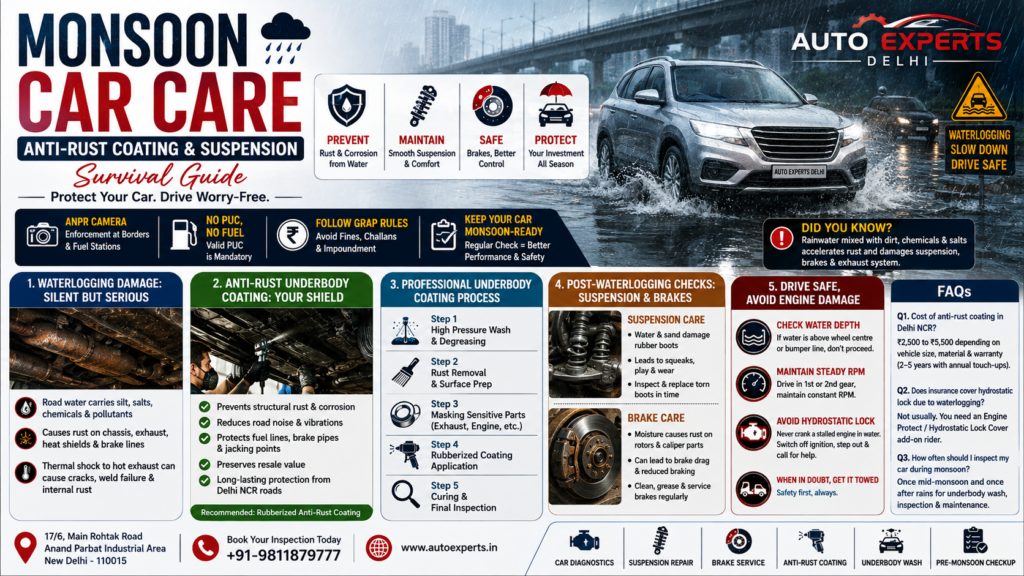
1. How Delhi Waterlogging Silently Damages Your Car Underbody
Modern automobiles feature protective factory coatings, but frequent driving through waterlogged roads in Delhi NCR gradually strips away these defense layers. Standing rainwater in urban areas is far from pure—it carries road chemicals, industrial pollutants, sewage runoff, and abrasive silt.
The Mechanism of Underbody Corrosion
Corrosion occurs when iron, oxygen, and water interact. Waterlogged Delhi roads act as an electrolyte solution that accelerates oxidation. When muddy rainwater splashes onto your car’s underbody, it gets trapped in small frame crevices, drain holes, and heat shields. As the moisture evaporates under high summer heat, it leaves behind a concentrated layer of dirt and salts that continuously eats away at bare metal.
Thermal Shock to the Exhaust System
Your car’s exhaust pipe and catalytic converter operate at temperatures exceeding $300^\circ\text{C}$ to $600^\circ\text{C}$. Submerging a scorching exhaust pipe into cool, stagnant rainwater induces severe thermal shock. This sudden temperature drop causes metal expansion and contraction, cracking welds, weakening exhaust mounts, and accelerating internal rusting inside the silencer box.
2. Anti-Rust Underbody Coating: Your Vehicle’s Primary Defense
Applying an aftermarket anti-rust underbody coating forms a durable chemical barrier between your car’s bare metal frame and environmental hazards.
Rubberized Anti-Rust Coating vs. Wax-Based Coatings
Not all underbody treatments offer identical protection against urban flooding. Selecting the correct material ensures long-term protection:
Benefits of Professional Underbody Coating
- Prevents Structural Rusting: Seals sheet metal seams, jacking points, and floor panels from direct contact with moisture.
- Improves NVH (Noise, Vibration, Harshness) Levels: Rubberized compounds absorb road gravel impacts and reduce tire noise inside the cabin during highway drives.
- Preserves Resale Value: Cars registered in Delhi NCR undergo strict inspection during ownership transfers. A rust-free chassis commands significantly higher market resale value.
- Protects Fuel Lines & Brake Pipes: Underbody steel brake and fuel lines are susceptible to corrosion. Coating them prevents dangerous fluid leaks.
3. Step-by-Step Professional Underbody Application Process
At Auto Experts Delhi, we follow a rigorous multi-stage procedure to ensure maximum adhesion and zero trapping of existing moisture.
4. Post-Waterlogging Suspension & Brake Maintenance Guide
When navigating deep water, the suspension system absorbs physical impacts while submerged. High-pressure water pushes grit into rubber boots, washing away factory lithium grease.
Protecting Rubber Bushings & Ball Joints
Your vehicle’s suspension relies on rubber-to-metal bonded bushings installed on control arms, sway bars, and shock absorbers.
- The Problem: Floodwater mixed with sand acts like liquid sandpaper. Once sand enters the rubber boot of a ball joint or tie rod end, it grinds down the internal nylon cup.
- The Symptom: Squeaking or creaking noises when turning the steering wheel or driving over Delhi’s speed breakers.
- The Fix: Post-monsoon inspection involves lifting the car on a hydraulic hoist, cleaning the boots, and replacing torn rubber dust covers before the entire ball joint fails.
Brake Rotor Oxidation & Caliper Sticking
Cast iron brake rotors oxidize rapidly when exposed to moisture. If a vehicle sits parked for 24 to 48 hours after driving through rain, a thick layer of orange surface rust binds the brake pads to the rotor.
- Light Surface Rust: Clears off naturally after two or three gentle stops on a dry road.
- Severe Pitting & Caliper Pin Seizure: Deep standing water washes away silicone grease on caliper slider pins. This causes uneven brake pad wear, brake dragging, and reduced stopping power. A thorough brake overhaul—including pin greasing and rotor resurfacing—restores braking efficiency.
5. Avoiding Hydrostatic Lock in Flooded Delhi Underpasses
Hydrostatic lock (hydrolock) occurs when water enters the engine’s air intake manifold and drawn into the combustion chambers. Because water is non-compressible, the moving pistons hit the water barrier, instantly bending connecting rods, cracking the engine block, or destroying the crankshaft.
Critical Rules for Driving Through Standing Water
- Assess Depth First: If water levels rise above the center cap of your wheels (or reach the lower bumper line), do not proceed. Seek an alternate route.
- Maintain Constant RPMs in 1st or 2nd Gear: Hold the clutch at the friction point (or hold the brake slightly in automatics) while pressing the accelerator to maintain elevated exhaust pressure. This prevents water from back-flowing into the tailpipe.
- Never Crank a Stalled Engine in Water: If your vehicle stalls while submerged, do not attempt to restart the engine. Attempting to turn the key pulls water deeper into the air filter box and cylinders. Switch off the ignition, abandon the vehicle safely, and call a professional towing service.
6. Frequently Asked Questions (FAQs)
Q1: What is the cost of anti-rust underbody coating in Delhi NCR?
The cost of a high-quality, professional rubberized underbody coating ranges from ₹2,500 for compact hatchbacks to ₹5,500 for full-sized SUVs. Prices vary based on vehicle chassis size, material quality, and warranty duration (typically 2 to 5 years with free annual touch-ups).
Q2: Does insurance cover hydrostatic engine lock caused by waterlogging?
Standard Comprehensive Auto Insurance policies generally do not cover engine damage caused by hydrostatic lock if you attempted to start the car in water. Coverage requires a dedicated “Engine Protect / Hydrostatic Lock Cover” add-on rider on your insurance policy.
Q3: How often should I inspect my car’s underbody during monsoon season?
It is recommended to schedule an underbody high-pressure wash and inspection once midway through the monsoon season and once immediately after the rains subside. This cleans away trapped mud and identifies torn rubber boots early.
Protect Your Vehicle with Auto Experts Delhi
Do not wait for rust to compromise your car’s structural frame or for suspension squeaks to turn into expensive mechanical repairs. At Auto Experts Delhi, we offer specialized post-monsoon maintenance, underbody rubberized coatings, and suspension diagnostics performed by certified technicians.
📍 Workshop Address: 17/6, Main Rohtak