






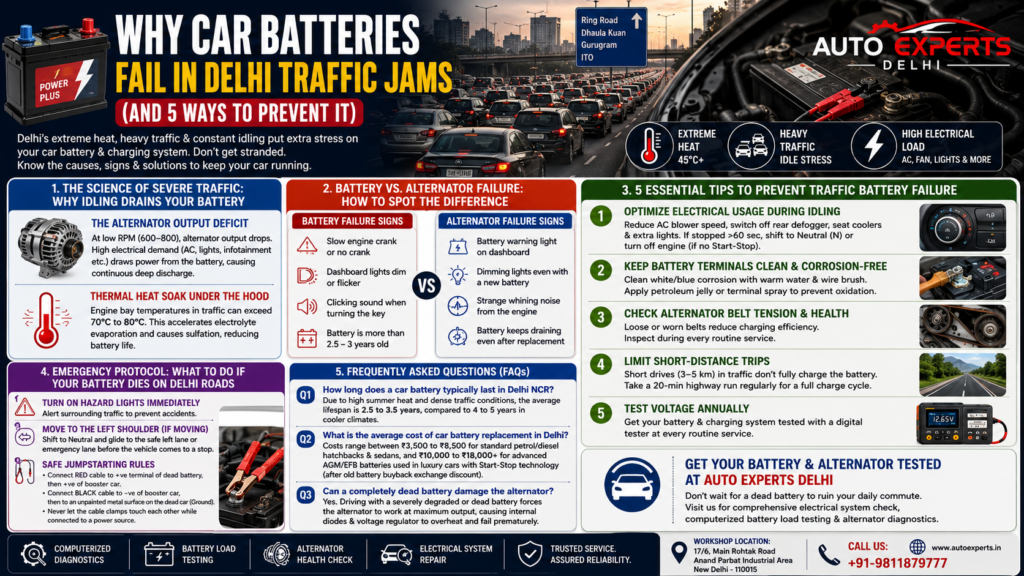
Why Car Batteries Fail in Delhi Traffic Jams
Navigating bumper-to-bumper traffic jams on the Ring Road, Delhi-Gurugram Expressway, ITO crossing, or Dhaula Kuan is a daily reality for drivers in Delhi NCR. Extreme summer temperatures hitting 45°C+, prolonged engine idling, and heavy electrical loads (radiator cooling fans, high-capacity ACs, dashcams, and infotainment screens) put immense strain on your vehicle’s battery and charging system.
Nothing is more frustrating than having your engine stall at a busy traffic signal with a completely dead battery.
In this comprehensive guide, our technical team at Auto Experts Delhi explains the science behind traffic-induced battery drain, signs of a failing alternator, and practical steps to ensure your battery never leaves you stranded in Delhi’s traffic.
1. The Science of Severe Traffic: Why Idling Drains Your Battery
Many car owners believe that whenever the engine is running, the battery is automatically charging. However, in low-RPM traffic conditions, this assumption is often incorrect.
The Alternator Output Deficit
An alternator relies on engine RPM to generate electric current. At highway speeds (2,000+ RPM), the alternator easily powers all electrical accessories while sending surplus current back to recharge the battery.
However, when idling in traffic at 600 to 800 RPM, an alternator operates at a fraction of its total capacity. If you operate full-blast air conditioning, headlights, wipers, and aftermarket sound systems simultaneously, the alternator cannot meet the electrical demand. The car’s electrical system begins drawing power directly from the battery, placing it in a continuous state of deep discharge.
Thermal Heat Soak Under the Hood
Delhi’s extreme summer heat exacerbates battery degradation. Engine bay temperatures during traffic idling frequently exceed 70°C to 80°C. High ambient heat accelerates the chemical reaction inside lead-acid batteries, causing the internal electrolyte fluid to evaporate and damaging the lead plates through sulfation.
2. Battery vs. Alternator Failure: How to Spot the Difference
When your car refuses to start or stalls unexpectedly, identifying whether the issue lies with the battery or the charging system saves both time and repair costs.
3. 5 Essential Tips to Prevent Traffic Battery Failure
You can protect your vehicle’s electrical health and extend battery lifespan in Delhi’s intense driving conditions by following these workshop-recommended practices:
1. Optimize Electrical Usage During Idling
When stuck in motionless traffic for extended periods:
- Turn down the AC blower fan speed by one or two notches.
- Switch off rear defoggers, seat coolers, and non-essential ambient lighting.
- If halted at a red light for longer than 60 seconds, shift to Neutral (N) or turn off the engine if your car lacks an automatic Start-Stop system (provided your battery is in good health).
2. Keep Battery Terminals Clean and Corrosion-Free
Extreme humidity during monsoons combined with heat causes white or bluish copper-sulfate powder buildup around battery terminals. This oxidation creates electrical resistance, preventing the alternator from fully charging the battery.
- DIY Cleaning: Pour warm water over the terminals to dissolve the crust, scrub gently with a wire brush, and apply a thin layer of petroleum jelly or terminal spray to prevent re-oxidation.
3. Check Alternator Belt Tension and Health
A loose or worn serpentine belt slips on the alternator pulley during heavy engine idling, reducing charging efficiency without showing an immediate error light on your dashboard. Ensure the drive belt tension is inspected during routine servicing.
4. Limit Short-Distance Trips
Repeated short drives under 3 to 5 kilometers in heavy traffic do not allow the alternator sufficient time to replenish the energy consumed during engine cranking. Take your vehicle on a periodic 20-minute highway run (e.g., Noida Expressway or Gurgaon Cyber City stretch) to achieve a full charge cycle.
5. Test Voltage Annually
Have your battery checked with a digital battery tester at every routine service.
4. Emergency Protocol: What to Do If Your Battery Dies on Delhi Roads
If your car battery dies unexpectedly on a congested Delhi road:
- Turn on Hazard Lights Immediately: Alert surrounding traffic to prevent rear-end collisions.
- Move to the Left Shoulder (If Moving): Shift to Neutral and glide to the safe left lane or emergency lane before the vehicle comes to a complete stop.
- Safe Jumpstarting Rules:
- Connect the RED jumper cable to the positive (+) terminal of the dead battery, then to the positive (+) of the booster car.
- Connect the BLACK cable to the negative (-) terminal of the booster car, and the other end to an unpainted metal surface on the dead car’s engine block (Grounding).
- Never let the cable clamps touch each other while connected to a power source.
5. Frequently Asked Questions (FAQs)
Q1: How long does a car battery typically last in Delhi NCR?
Due to high summer heat and dense traffic conditions, the average lifespan of a car battery in Delhi NCR is 2.5 to 3.5 years, compared to 4 to 5 years in cooler climates.
Q2: What is the average cost of car battery replacement in Delhi?
Car battery replacement costs in Delhi NCR range between ₹3,500 and ₹8,500 for standard petrol/diesel hatchbacks and sedans, and ₹10,000 to ₹18,000+ for advanced AGM/EFB batteries used in luxury cars with Start-Stop technology (after old battery buyback exchange discount).
Q3: Can a completely dead battery damage the alternator?
Yes. Driving with a severely degraded or dead battery forces the alternator to continuously operate at maximum output to keep the vehicle running. Over time, this causes the alternator’s internal diodes and voltage regulator to overheat and fail prematurely.
Get Your Battery & Alternator Tested at Auto Experts Delhi
Don’t wait for a dead battery to ruin your daily commute. Visit Auto Experts Delhi for a comprehensive electrical system check, computerized battery load testing, and alternator health diagnostics.
- 📍 Workshop Location: 17/6, Main Rohtak Road Anand Parbat Industrial Area New Delhi ,110015
- 📞 Call Us: +91-9811879777