




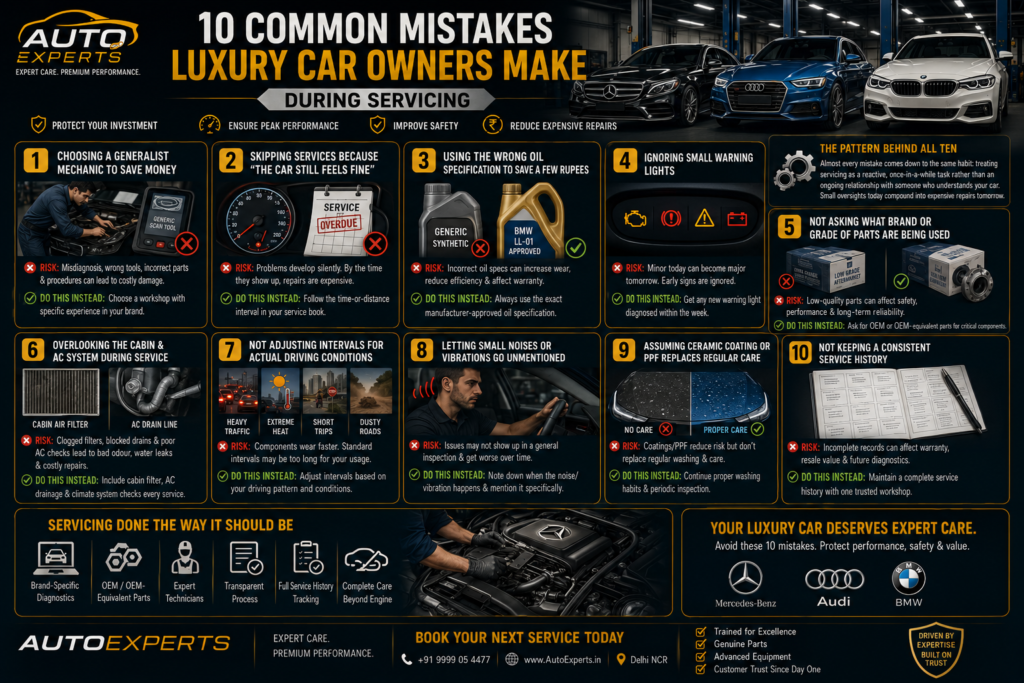
10 Common Mistakes Luxury Car Owners Make During Servicing
Owning a Mercedes-Benz, Audi, or BMW comes with a certain assumption: that the car, being premium, will simply hold up well with minimal thought. In practice, the opposite is closer to true — these vehicles reward proactive, informed maintenance and are less forgiving of shortcuts than a mainstream car might be.
Most of the expensive repairs we see didn’t start as sudden failures. They started as small, avoidable decisions made during routine servicing. Here are the ten mistakes we see most often — and what to do instead.
1. Choosing a Generalist Mechanic to Save Money
It’s a reasonable instinct: a generalist workshop often quotes less than a brand-specialist one. But luxury vehicles use proprietary diagnostic software, brand-specific torque specs, and components that don’t always behave like their mainstream equivalents.
The risk: A generalist mechanic might misread a fault code that’s normal for a Mercedes or BMW but would signal a real problem on another brand, or use a generic part that doesn’t match the engineering tolerance the car was built around.
Do this instead: Use a workshop with specific experience on your brand, even if the upfront cost is slightly higher. The cost of a misdiagnosis is almost always greater than the savings from a cheaper shop.
2. Skipping Services Because “The Car Still Feels Fine”
This is the single most common mistake, and it comes from a fair assumption — if nothing feels wrong, why spend money? The problem is that scheduled maintenance exists precisely to catch things before they feel wrong.
The risk: Oil degrades, brake pads thin, and fluids age on a timeline that has nothing to do with how the car feels to drive. By the time a problem is noticeable, it’s often already progressed past the cheap-fix stage.
Do this instead: Follow the time-or-distance interval in your service book, whichever comes first — not how the car feels on a given day.
3. Using the Wrong Oil Specification to Save a Few Rupees
Not all “synthetic” oil is the same. Manufacturers specify exact approved specifications (like BMW LL-01 or Mercedes MB 229.5) that are engineered around how that specific engine runs — its turbo, its tolerances, its emissions system.
The risk: A cheaper synthetic that doesn’t meet the exact spec can still cause increased wear over time, and in some cases, using an unapproved oil can affect warranty claims if an engine issue arises later.
Do this instead: Always confirm the exact spec required for your model — not just “synthetic” as a general category — and make sure it’s what’s actually being used at every service.
4. Ignoring Small Warning Lights Because “It’s Probably Nothing”
A dashboard light that stays on gets mentally filed away as background noise after a while, especially if the car still drives normally.
The risk: Warning lights exist because a sensor detected something outside normal range — sometimes minor, sometimes an early sign of a bigger issue. Driving with it ignored for months means losing the early-detection advantage the system was designed to give you.
Do this instead: Get any new warning light diagnosed within the week, even if the car seems to be driving fine. A diagnostic scan is quick and tells you definitively whether it’s minor or worth addressing now.
5. Not Asking What Brand or Grade of Parts Are Being Used
It’s easy to assume “genuine parts” are automatically being used at every service, especially at a shop that specializes in luxury brands. That’s not always the case unless it’s specifically confirmed.
The risk: Aftermarket parts vary hugely in quality. Some match OEM standards closely; others don’t, and using a lower-grade part in a critical system — brakes, suspension, filtration — can affect both performance and longevity.
Do this instead: Ask directly what parts are being used for any given repair, and request OEM or OEM-equivalent parts for anything safety-critical or performance-relevant.
6. Overlooking the Cabin and AC System During Service
Engine-related maintenance tends to get all the attention, while cabin air filters, AC drainage, and climate system checks get treated as optional extras.
The risk: A clogged cabin filter or blocked AC drain doesn’t just reduce comfort — it can strain the blower motor, cause musty odors, or in worse cases, lead to water pooling inside the cabin from a blocked drain line.
Do this instead: Make sure cabin filters, AC drainage, and climate system performance are part of your standard service checklist, not something you have to remember to ask about separately.
7. Not Adjusting Service Intervals for Actual Driving Conditions
Manufacturer service intervals assume “average” driving conditions. Heavy traffic, extreme heat, frequent short trips, or dusty roads all count as more demanding than average — but most owners stick to the standard interval regardless.
The risk: A car driven mostly in stop-and-go city traffic or extreme heat wears components faster than the standard interval accounts for, meaning sticking rigidly to “12 months or 15,000 km” can mean servicing later than the car actually needs.
Do this instead: Talk to your service advisor about your actual driving pattern and adjust intervals accordingly — particularly oil changes, filters, and brake inspections.
8. Letting Small Noises or Vibrations Go Unmentioned
Owners often notice a faint new noise or vibration, decide it’s minor, and simply forget to mention it at the next service, assuming the technician will catch it during inspection.
The risk: A general inspection doesn’t always reproduce every driving condition where a specific noise occurs — a rattle at a certain speed, a vibration during braking, a click only under acceleration. Technicians rely on owner input to know exactly where to focus.
Do this instead: Keep a simple note on your phone of anything unusual you notice between services — when it happens, at what speed, under what conditions — and mention it specifically rather than assuming it’ll be caught automatically.
9. Assuming Ceramic Coating or PPF Replaces Regular Washing and Care
Paint protection products are sometimes treated as a “set it and forget it” solution, leading owners to wash and care for the car less carefully than before.
The risk: Ceramic coating and PPF reduce certain kinds of damage, but they don’t make paint immune to everything — improper washing techniques, harsh chemicals, or long-term dirt buildup can still degrade the finish underneath, and neither product protects against dents regardless of what it protects against.
Do this instead: Continue proper washing habits and periodic inspection even after paint protection is applied — think of it as reducing risk, not eliminating maintenance.
10. Not Keeping a Consistent Service History
Some owners split servicing between multiple workshops based on convenience or price for each individual job, without realizing this fragments the car’s service record.
The risk: A consistent, documented service history matters for two practical reasons: it protects warranty claims by proving maintenance was properly followed, and it gives any technician working on the car full context on what’s been done and when — without it, minor issues can get missed simply because no one has the full picture.
Do this instead: Where possible, keep servicing consistent with one trusted workshop that maintains a full record of your car’s history, making it easier to spot patterns and catch issues early.
The Pattern Behind All Ten
Almost every mistake on this list comes down to the same underlying habit: treating servicing as a reactive, once-in-a-while task rather than an ongoing relationship with someone who understands your specific car. Luxury vehicles are engineered with tighter tolerances and more interconnected systems than mainstream cars, which means the margin for “good enough” maintenance is smaller — small oversights tend to compound faster and cost more to reverse.
Servicing Done the Way It Should Be
At AutoExperts, we specialize exclusively in Mercedes-Benz, Audi, and BMW vehicles — which means brand-specific diagnostics, OEM-grade parts, full service history tracking, and a checklist that goes beyond just the engine. Book your next service with us, and avoid learning these ten lessons the expensive way.