






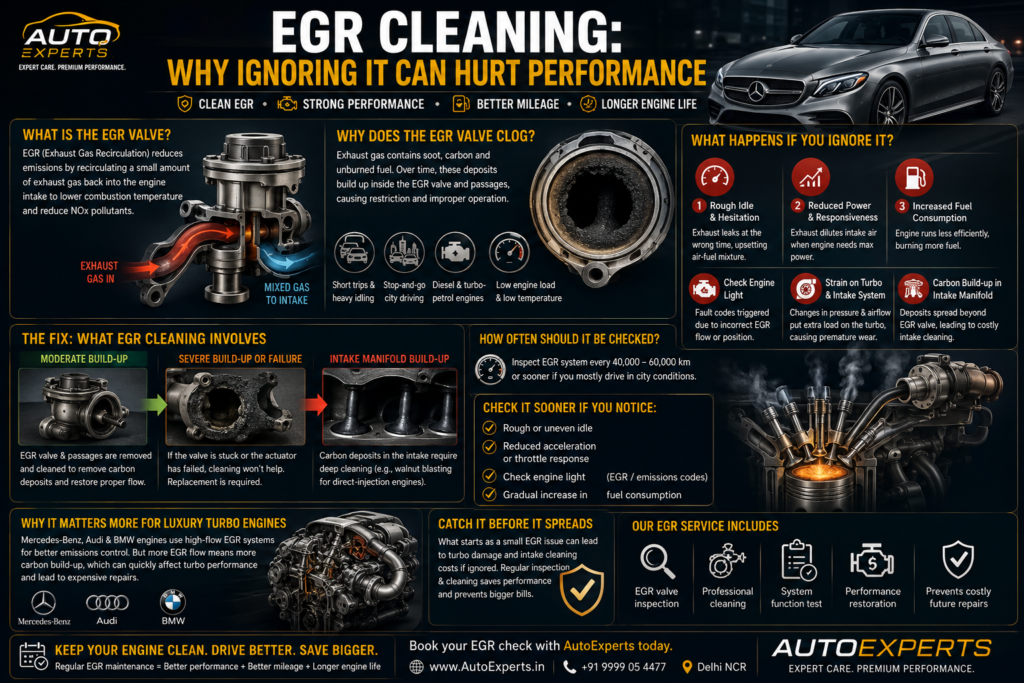
EGR Cleaning: Why Ignoring It Can Hurt Performance
Ask most car owners what an EGR valve does, and you’ll get a blank look — it’s one of those components that quietly does its job for years until it doesn’t, and by then the symptoms (rough idle, reduced power, a stubborn check engine light) rarely point directly to the actual cause. That disconnect is exactly why EGR maintenance gets skipped more than almost anything else on a service checklist.
Here’s what the EGR valve actually does, why it clogs, and why letting it go too long costs you more than just performance.
What the EGR Valve Actually Does
EGR stands for Exhaust Gas Recirculation. Its job is to take a small, controlled portion of exhaust gas and route it back into the engine’s intake, mixing it with the incoming air-fuel charge.
This might sound counterintuitive — why put exhaust back into the engine? The answer is emissions control: recirculating some exhaust gas lowers the peak combustion temperature inside the cylinders, which significantly reduces the formation of nitrogen oxides (NOx), a major pollutant. It’s a core part of how modern engines meet emissions standards without sacrificing too much performance.
The valve itself opens and closes based on engine load and speed, managed by the engine control unit, to let exactly the right amount of exhaust gas back in at the right time.
Why It Clogs
The exhaust gas being recirculated isn’t clean — it carries soot, carbon particles, and unburned fuel residue, especially in diesel and modern turbo-petrol engines. Every time that gas passes through the EGR valve and its passages, a small amount of this residue deposits on the surfaces it touches.
Over time, this builds into a hard, carbon-like buildup that narrows the valve’s passages and can eventually prevent it from opening and closing fully.
What makes it worse:
- Short trips and heavy idling: The engine never reaches a high enough sustained temperature to burn off deposits naturally, which happens more readily during longer, higher-load driving. Stop-and-go city traffic is exactly the kind of driving that accelerates EGR carbon buildup.
- Frequent low-speed city driving: Similar to short trips, low engine loads mean more EGR flow relative to overall combustion, and less opportunity for the system to self-clean.
- Diesel and modern turbo-petrol engines specifically: These engines tend to run more EGR flow than older, simpler naturally aspirated engines, meaning more exhaust residue passes through the system over the same distance driven.
What Happens When You Ignore It
1. Rough Idle and Hesitation
A partially stuck or clogged EGR valve often gets stuck slightly open or fails to close fully, letting exhaust gas leak into the intake when the engine doesn’t need it — at idle or during light acceleration, for example. This throws off the precise air-fuel mixture the engine is expecting, leading to a rough, uneven idle or a hesitation when you press the accelerator.
2. Reduced Power and Responsiveness
When the EGR valve doesn’t close properly during acceleration, exhaust gas dilutes the air-fuel charge exactly when the engine needs maximum clean air for power. This shows up as sluggish acceleration or a noticeable dip in responsiveness — often mistaken for a general “the car feels older” issue rather than a specific, fixable cause.
3. Increased Fuel Consumption
An engine compensating for an improperly functioning EGR system often runs a less efficient combustion cycle, burning more fuel to produce the same power output. This tends to be gradual enough that owners don’t notice it as a sudden change — just a slow creep in how often they’re filling up.
4. Check Engine Light and Fault Codes
Modern engine control units actively monitor EGR valve position and flow. A valve that’s stuck, slow to respond, or flowing incorrectly will typically trigger a fault code and the check engine light — often one of the more common reasons for an unexplained warning light on higher-mileage vehicles.
5. Increased Strain on the Turbo and Intake System
This is the consequence that turns a moderate problem into an expensive one. A malfunctioning EGR system changes the pressure and airflow dynamics the turbocharger is designed around, forcing it to work outside its optimal range to compensate. Over time, this added strain accelerates wear on turbo components — bearings and seals that are considerably more expensive to replace than an EGR valve on its own.
6. Carbon Buildup Spreading to the Intake Manifold
Left unaddressed long enough, the same carbon deposits clogging the EGR valve continue building up in the intake manifold and intake valves downstream, since that’s where the recirculated exhaust gas ultimately travels. What started as a contained issue in one valve becomes a broader intake cleaning job, which is a more labor-intensive and costly service than addressing the EGR valve on its own.
The Fix: What EGR Cleaning Actually Involves
For moderate buildup: The EGR valve and its surrounding passages are removed and cleaned, dissolving and scraping away carbon deposits to restore proper flow and function. This is a well-established, relatively affordable service that resolves the vast majority of early to moderate EGR issues.
For severe buildup or valve failure: If the valve itself has failed mechanically — stuck open, stuck closed, or the internal actuator has worn out — cleaning alone won’t resolve it, and the valve needs to be replaced. This is a more significant cost, which is exactly why catching the issue at the cleaning stage matters.
For intake manifold carbon buildup: If deposits have spread beyond the EGR valve itself, a broader intake cleaning service — sometimes called walnut-shell blasting on direct-injection engines — is needed to restore proper airflow through the intake valves.
How Often Should It Be Checked?
There’s no universal mileage figure here, since it depends heavily on driving conditions, but a reasonable general guide is an EGR inspection every 40,000–60,000 km — sooner if you do mostly short, low-speed city driving, and it’s worth asking specifically at your next service, since EGR checks aren’t always part of a standard inspection checklist by default.
Signs it’s time to check now, regardless of mileage:
- A rough or uneven idle that wasn’t there before
- Noticeably reduced acceleration or throttle response
- A check engine light, particularly with codes related to EGR flow or emissions
- A gradual increase in fuel consumption without any other explanation
Why This Matters More for Luxury Turbo Engines
Mercedes-Benz, Audi, and BMW engines — particularly diesel and turbocharged petrol variants — tend to run more sophisticated, higher-flow EGR systems than simpler naturally aspirated engines, precisely because they’re engineered to meet strict emissions standards while still delivering strong performance. That sophistication is a double-edged sword: it means better emissions control under normal conditions, but also more exhaust residue passing through the system over time, and a tighter relationship between EGR function and turbo performance. A clogged EGR valve on these engines doesn’t stay an isolated issue for long — it tends to ripple outward into turbo strain and intake carbon buildup faster than it would on a simpler engine.
Catch It Before It Spreads
EGR problems follow the same pattern as most of the issues that quietly damage luxury engines: they start small, contained, and inexpensive to fix — and they get more expensive the longer they’re left unaddressed, eventually pulling the turbo and intake system into the problem with them.
At AutoExperts, EGR inspection and cleaning is something we specifically check for on turbo and diesel Mercedes, Audi, and BMW models, especially if your driving is mostly city-based. Book an EGR check with us, and keep that rough idle or sluggish acceleration from turning into a bigger repair down the line.