



Why Your Steering Feels Heavy: Common Reasons Explained
Power steering is one of those systems you only really notice when it stops working the way it should. A steering wheel that suddenly feels heavier — harder to turn at low speed, more effort needed in parking lots, less responsive on the highway — is a clear signal that something in the system isn’t performing correctly, even if the car otherwise drives normally.
Here’s what’s usually behind it, and what actually needs attention depending on the cause.
First, What Kind of Steering System Does Your Car Have?
This matters because the likely causes differ:
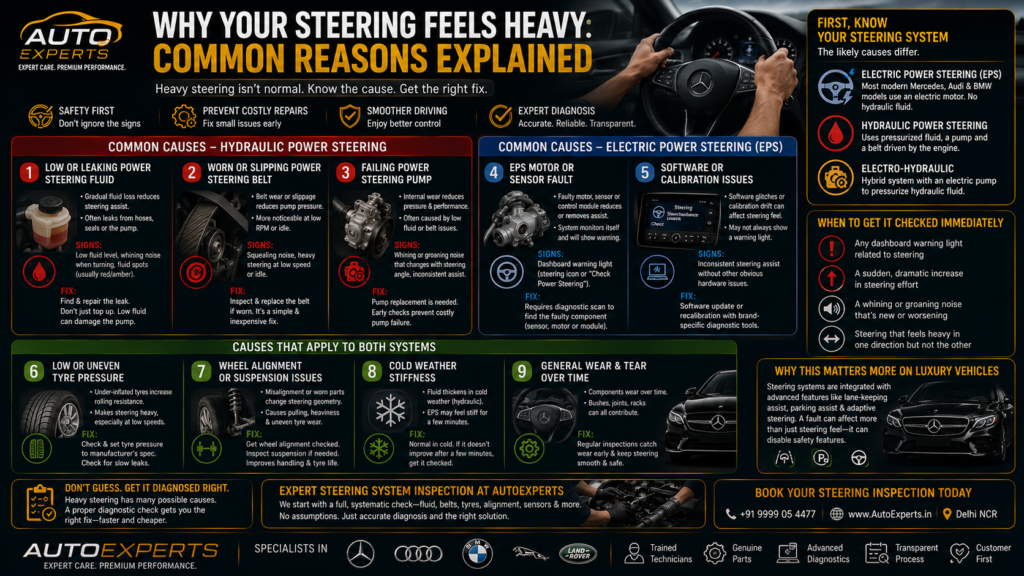
- Electric Power Steering (EPS): Most modern Mercedes-Benz, Audi, and BMW models use this — an electric motor assists steering effort, with no hydraulic fluid involved.
- Hydraulic Power Steering: Common on older models, this uses pressurized fluid, a pump, and often a belt driven by the engine to provide steering assistance.
- Electro-hydraulic: A hybrid of the two, found on some models, using an electric pump to pressurize hydraulic fluid.
Knowing which system your car uses narrows down the likely cause considerably, so if you’re not sure, it’s worth checking your owner’s manual or asking your service advisor.
Common Causes on Hydraulic Power Steering Systems
1. Low or Leaking Power Steering Fluid
This is the most common cause on hydraulic systems, and often the easiest to catch early — a slow leak from a hose, seal, or the pump itself gradually reduces fluid level, and with it, the system’s ability to assist steering effort.
How to tell: Check the power steering fluid reservoir level, and look for any fluid spots under the front of the car, typically a reddish or amber color. A whining noise when turning the wheel, especially at low speed, often accompanies low fluid.
The fix: A slow leak is usually a straightforward seal or hose repair when caught early. Simply topping up fluid without finding the leak is a short-term fix — it’ll drop again, and continuing to drive with very low fluid can damage the power steering pump itself, turning a modest repair into a considerably more expensive one.
2. Worn or Slipping Power Steering Belt
On hydraulic systems, the power steering pump is typically driven by a belt connected to the engine. A worn, glazed, or slipping belt reduces how effectively the pump can build pressure.
How to tell: Steering that feels heavy specifically at low RPM or idle, sometimes paired with a squealing noise on startup or during hard turns, points toward belt slippage.
The fix: Belt inspection and replacement is a routine, inexpensive service — worth checking at scheduled intervals, since a belt showing early wear is easy to replace proactively before it fails.
3. Failing Power Steering Pump
If fluid levels are fine and the belt is in good condition, but steering still feels heavy or inconsistent, the pump itself may be wearing out internally.
How to tell: A whining or groaning noise that changes with steering angle, along with steering effort that feels inconsistent rather than uniformly heavy, often points to the pump.
The fix: Pump replacement is a more involved repair than a fluid top-up or belt change, which is exactly why catching fluid leaks and belt wear early matters — both are common contributors to premature pump failure.
Common Causes on Electric Power Steering (EPS) Systems
4. EPS Motor or Sensor Fault
Electric power steering relies on a torque sensor and electric motor working together, managed by a control module. A fault in any of these components can reduce or eliminate steering assist.
How to tell: Heavy steering on an EPS-equipped car is often paired with a dashboard warning light (commonly a steering wheel icon or “check power steering” message), since the system actively monitors itself.
The fix: This requires a proper diagnostic scan to identify which component is at fault — the sensor, the motor, or the control module — since guessing at replacement parts on an EPS system can be costly if the wrong component is swapped.
5. Software or Calibration Issues
EPS systems are software-managed, and occasionally a calibration drift or an outdated software version can cause the steering assist to feel inconsistent or heavier than expected, even without a hardware fault.
How to tell: This is harder to self-diagnose, since it doesn’t always trigger an obvious warning light — inconsistent assist that doesn’t match any of the other causes on this list is worth raising with a technician who can check for pending software updates.
The fix: A software recalibration or update, done through brand-specific diagnostic tools, can resolve this without any parts replacement at all — one of the few causes on this list that’s a pure software fix.
Causes That Apply to Both Systems
6. Low or Uneven Tyre Pressure
This is one of the simplest, most overlooked causes. Under-inflated tyres increase the contact patch and rolling resistance, which makes the steering feel noticeably heavier, particularly at low speeds like parking maneuvers.
How to tell: Check tyre pressure against the manufacturer-recommended figure (usually on a sticker inside the driver’s door). Heavy steering that’s specifically worse at parking-lot speeds and normal on the highway often points here first, since it’s the quickest thing to rule out.
The fix: Adjust pressure to spec. If this resolves the heaviness, no further diagnosis is needed — though it’s worth checking why the pressure was off (a slow leak versus simply overdue for a check).
7. Wheel Alignment or Suspension Issues
Misalignment or worn suspension components change the geometry the steering system is working against, which can make the wheel feel heavier, pull to one side, or feel inconsistent through turns.
How to tell: Heavy steering paired with the car pulling to one side, uneven tyre wear, or a vibration through the wheel points toward alignment or suspension rather than the power steering system itself.
The fix: A wheel alignment check is a quick, inexpensive diagnostic step, and often resolves the issue directly if that’s the cause. If suspension components are worn, that’s a separate repair, but one worth catching early since it also affects tyre wear and handling.
8. Cold Weather Stiffness
In colder conditions, power steering fluid (on hydraulic systems) can thicken slightly, and even EPS systems can feel marginally stiffer in the first few minutes after a cold start.
How to tell: Heaviness that’s specifically worse right after starting the car in cold weather, then improves within a few minutes of driving, is usually just temporary cold-weather behavior rather than a fault.
The fix: No repair needed if it resolves quickly on its own — but if the heaviness persists well beyond the first few minutes of driving, that points to one of the other causes above rather than simply cold weather.
When to Get It Checked Immediately
While some causes on this list are minor, a few deserve prompt attention rather than waiting for a scheduled service:
- Any dashboard warning light related to steering
- A sudden, dramatic increase in steering effort (rather than a gradual change)
- A whining or groaning noise that’s new or worsening
- Steering that feels heavy in one direction but not the other
Steering is a safety-critical system, and sudden or dramatic changes — as opposed to a gradual shift you’ve noticed over weeks — are worth same-day attention rather than waiting.
Why This Matters More on Luxury Vehicles
Mercedes-Benz, Audi, and BMW EPS systems are often integrated with broader driver-assistance features — lane-keeping assist, parking assistance, adaptive steering weight that changes with driving mode — which means a fault in the steering system can affect more than just steering feel; it can disable or degrade related assistance features that depend on the same sensors and motor.
Get to the Actual Cause, Not Just a Guess
Heavy steering has enough possible causes that guessing rarely leads to the right fix on the first try — a proper diagnostic check, starting with the basics like tyre pressure and fluid level before moving to sensors or pumps, gets you to the actual answer faster and cheaper.
At AutoExperts, we start every heavy-steering diagnosis with a full systematic check rather than assuming the most expensive cause first. Book a steering system inspection with us, and get back to a wheel that feels the way it should.