






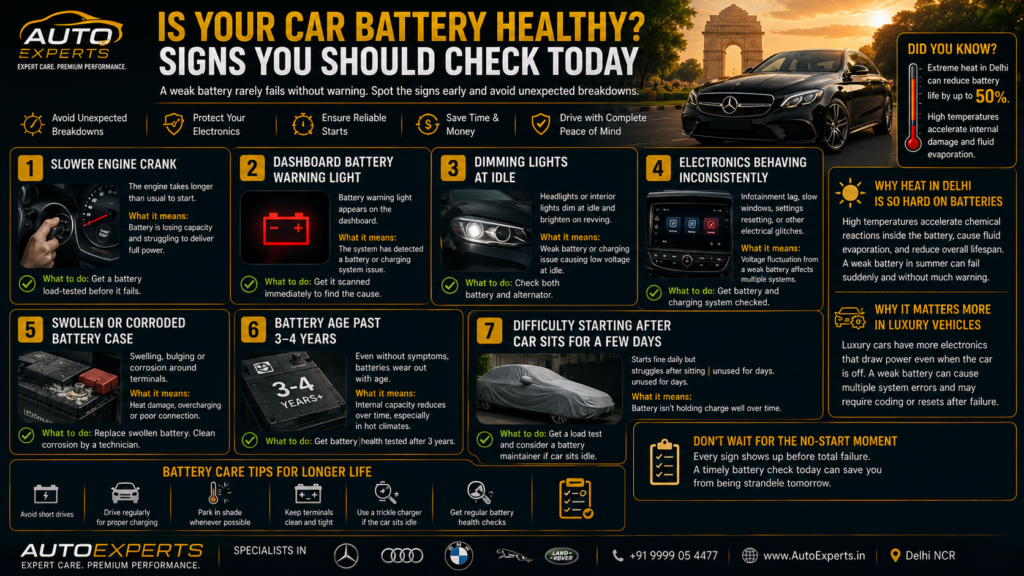
Is Your Car Battery Healthy? Signs You Should Check Today
A dead battery has a way of announcing itself at the worst possible moment — a Monday morning meeting, a highway trip you’re already running late for, a hot afternoon with the AC on full blast. What makes it frustrating is that batteries rarely fail without warning. They usually give off subtle signs for weeks, sometimes months, before finally giving out — most owners just don’t know what to look for until it’s too late.
Here’s what your battery is actually telling you, and when those signs mean it’s time for a check rather than a wait-and-see approach.
1. Slower Engine Crank
This is usually the earliest and most reliable sign. If turning the key or pressing start results in the engine cranking noticeably slower than usual — a bit of hesitation before it catches — that’s the battery struggling to deliver full power to the starter motor.
What it means: A battery losing capacity can still start the car for a while, just with less margin each time. This is the stage where a check makes the biggest difference, since the battery hasn’t failed yet — it’s just weakening.
What to do: Get the battery load-tested rather than waiting for it to fully die. A load test measures actual capacity under demand, which tells you definitively whether it’s a battery issue or something else, like a starter motor problem.
2. Dashboard Battery Warning Light
Modern Mercedes, Audi, and BMW models monitor battery health and charging system performance continuously, and a battery warning light appearing is a direct signal that the system has detected a real issue — either with the battery itself or the alternator’s ability to charge it.
What it means: This light isn’t something to drive around for a few days assuming it’ll resolve itself. It’s the car’s electrical system flagging a specific, detected problem.
What to do: Get it scanned as soon as possible. The diagnostic will tell you whether it’s the battery, the alternator, or a charging system fault — each requires a different fix, and driving on a failing charging system can leave you stranded with very little warning.
3. Dimming Headlights or Interior Lights at Idle
If your headlights or interior lights seem to dim slightly when the engine is idling — particularly if they brighten again when you rev the engine — that’s a sign the electrical system isn’t getting consistent power at low RPM, often pointing to a weakening battery or charging issue.
What it means: At idle, the alternator produces less charging power, so if the battery isn’t holding a strong charge on its own, the electrical system has less to draw from, and lights are often the most visible symptom.
What to do: This is worth a battery and alternator check together, since the symptom overlaps between the two — a technician can isolate which one is actually the cause.
4. Electronics Behaving Inconsistently
Luxury vehicles run a lot of electronics — infotainment systems, power windows, seat memory functions, climate control — all of which depend on stable voltage. A weakening battery can cause these systems to behave oddly: a slow-responding infotainment screen, windows that move sluggishly, or settings that occasionally reset.
What it means: These systems are sensitive to voltage fluctuation, and inconsistent behavior across multiple electronics at once is a more telling sign than any single glitch on its own.
What to do: If you notice several small electrical quirks appearing around the same time, rather than troubleshooting each one separately, have the battery and charging system checked as the likely common cause.
5. A Swollen or Corroded Battery Case
This one’s visible if you actually look — pop the hood and check the battery case for any bulging, swelling, or a white/greenish crusty buildup around the terminals.
What it means: A swollen case usually indicates the battery has been exposed to excessive heat or has been overcharged, both of which damage the internal cells. Corrosion at the terminals restricts the electrical connection, which can mimic the symptoms of a weak battery even if the battery itself is otherwise fine.
What to do: A swollen battery should be replaced — this isn’t a repair situation, it’s a safety one, since a damaged case can leak or, in rare cases, rupture. Corrosion, on the other hand, can often be cleaned by a technician, which alone sometimes resolves what looked like a battery problem.
6. Battery Age Past 3-4 Years
Even a battery showing no symptoms at all is worth checking proactively once it crosses the 3-4 year mark, which is the general lifespan for most standard car batteries under normal conditions — shorter in consistently hot climates like Delhi, where heat accelerates internal degradation.
What it means: Batteries don’t always decline gradually and predictably — some hold a reasonably strong charge until fairly close to failure, then drop off quickly. Age alone is a legitimate reason to test, even without other symptoms present.
What to do: Have battery health tested as part of routine servicing once it’s past the 3-year mark, rather than waiting for a symptom to prompt the check.
7. Difficulty Starting After the Car Sits for a Few Days
If your car starts fine when driven daily but struggles after sitting unused for a few days — a weekend car, a second vehicle, or simply a few days without use — that’s a sign the battery isn’t holding charge well over time, even if it seems fine during regular use.
What it means: A healthy battery should hold a charge for well over a week of inactivity under normal conditions. Struggling after just a few days points to reduced capacity, even if daily starts still feel normal.
What to do: If this happens more than once, it’s worth a load test rather than assuming it’s a one-off. For vehicles that sit unused often, a trickle charger or battery maintainer can also help extend battery life between drives.
Why Heat Makes This More Urgent in Delhi
Extreme heat is harder on car batteries than cold weather, since high temperatures accelerate the internal chemical reactions that degrade a battery and speed up fluid evaporation inside it. In Delhi’s summer conditions, a battery already showing early warning signs is far more likely to fail without much additional warning, often on a hot afternoon with the AC running at full load — exactly the kind of moment you’d most want to avoid a breakdown.
Why This Matters More on Luxury Vehicles
Mercedes-Benz, Audi, and BMW models run considerably more electronics than a basic vehicle — advanced infotainment, multiple driver assistance sensors, adaptive lighting, memory seat functions — all of which draw continuously from the battery, even when the car is off. A weak battery on these vehicles tends to show symptoms across multiple systems at once, and in some cases, a full battery failure can require more than a simple jump-start to recover, since certain modules need to properly reset once power is restored.
Don’t Wait for the No-Start Moment
Every sign on this list shows up before the battery fully fails — which means there’s almost always a window where a load test and, if needed, a replacement can happen on your schedule, rather than as an emergency roadside call.
At AutoExperts, we include battery health as part of every service check, especially heading into Delhi’s summer months. Book a battery check with us today, and make sure your car starts exactly when you need it to.