



Introduction
Your car talks to you every single day — through sounds, smells, vibrations, and small changes in the way it drives. The problem is, most of us are too busy to listen. We turn up the radio, tell ourselves “it’s probably nothing,” and drive on.
For luxury vehicles like Mercedes-Benz, Audi, and BMW, that habit can be an expensive one. These cars are engineered with precision — tighter tolerances, more sensors, and more interconnected systems than the average vehicle. That means small issues rarely stay small for long. What starts as a faint noise or a flickering light can quietly turn into a five-figure repair if it’s ignored long enough.
The good news? Your car is almost always giving you a heads-up before something fails. Here are seven warning signs worth paying attention to — and what to actually do about them.
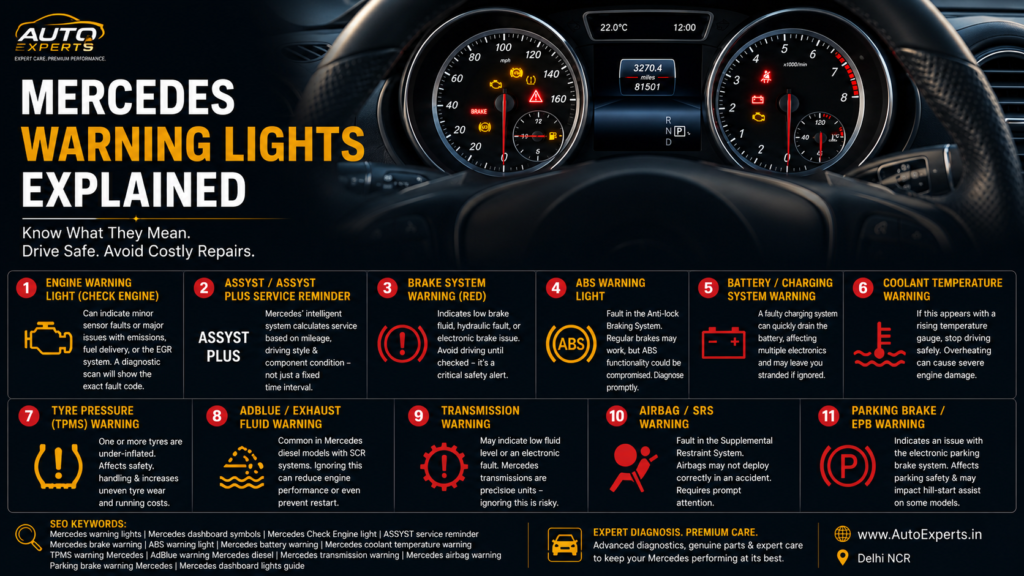
1. Dashboard Warning Lights That Won’t Go Away
That little light on your dash isn’t decoration. Modern Mercedes, Audi, and BMW models run dozens of sensors that monitor everything from engine performance to tire pressure to emissions. When one of them detects something outside the normal range, it lights up — often long before you’d notice any change in how the car drives.
What it usually means: Anything from a loose gas cap to a failing sensor to an early-stage engine issue.
The fix: Don’t guess, and don’t ignore it. A proper diagnostic scan reads the exact fault code your car’s computer has logged, which tells a technician precisely where to look. This is a 15-20 minute job that can save you from driving around with an undiagnosed problem for weeks.
2. Squealing, Grinding, or Clicking Brakes
Brakes are one of the few systems where the car will very deliberately warn you before things get serious. Many German-engineered brake pads have a built-in wear indicator — a small metal tab that touches the rotor and produces a high-pitched squeal once the pad is thinning out. If you hear grinding instead of squealing, that usually means the pad is gone and metal is now touching metal.
What it usually means: Worn brake pads, warped rotors, or in more serious cases, caliper issues.
The fix: Squealing means “book a service this week.” Grinding means “don’t drive it further than you have to — get it checked immediately.” On premium vehicles, rotors and calipers are precision components, and catching pad wear early is far cheaper than replacing rotors that have been scored by worn-out pads.
3. A Steering Wheel That Vibrates or Pulls
If your steering wheel shakes at highway speed, or your car quietly drifts to one side when you take your hands off the wheel for a second, that’s your suspension and alignment system talking.
What it usually means: Unbalanced tires, a wheel alignment issue, worn suspension components, or in some cases a warped brake rotor (vibration specifically under braking).
The fix: A wheel alignment and balance check is quick and inexpensive — and it directly affects tire lifespan. Left unaddressed, poor alignment wears your tires unevenly and puts extra strain on suspension parts that are far pricier to replace than a set of tires.
4. Unusual Smells Inside or Outside the Cabin
Smell is one of the most underrated diagnostic tools you have. A sweet smell often points to coolant, a sharp burning smell points to oil or clutch components, and a rotten-egg smell usually points to the catalytic converter or fuel system.
What it usually means:
- Sweet smell → coolant leak
- Burning oil smell → an oil leak dripping onto a hot engine part
- Rotten egg smell → catalytic converter or fuel system issue
- Burning rubber → a slipping belt or hose rubbing against something hot
The fix: Any of these deserve a same-week inspection. Coolant and oil leaks are especially important to catch early on turbocharged luxury engines, where overheating or low oil pressure can cause serious damage in a short amount of time.
5. Engine Noises That Weren’t There Before
A knocking, ticking, or whining sound from under the hood is one of the clearest signs your engine wants attention. On high-performance German engines, these sounds often show up early — well before any dashboard light does — because the components involved are built to such tight tolerances that even small wear is audible.
What it usually means: Low oil level or pressure, a failing belt tensioner, worn engine mounts, or valve train wear.
The fix: Get it heard by a technician who knows the platform. A whine that’s normal on one model can be a warning sign on another, which is why brand-specific experience matters here — a generalist mechanic may not recognize the difference between a “normal” BMW fuel pump whine and one that signals early failure.
6. A Transmission That Hesitates or Shifts Roughly
Smooth, seamless gear changes are a hallmark of luxury vehicles — so when a shift feels delayed, jerky, or the car seems to “think” before changing gears, it’s worth taking seriously. Automatic transmissions in these vehicles are complex, computer-managed systems, and rough shifting is often one of the first signs that something’s off with the transmission fluid, a sensor, or the mechatronic unit.
What it usually means: Low or degraded transmission fluid, a software calibration issue, or early wear in transmission components.
The fix: In many cases, this is caught early with a fluid service and a diagnostic scan — both relatively minor. Ignored, it can progress to a transmission that needs a full rebuild, which is one of the most expensive repairs a luxury car owner can face.
7. Reduced Power or a Rough Idle
If your car feels sluggish off the line, hesitates when you accelerate, or shakes slightly at a stoplight, your engine is telling you it isn’t running as efficiently as it should be.
What it usually means: A dirty or failing sensor (like a mass airflow sensor), a misfire, a fuel delivery issue, or a small vacuum leak.
The fix: These issues are usually inexpensive to fix on their own — a sensor cleaning or replacement, a fuel injector service — but left alone, they force the engine to work harder than it should, which accelerates wear on other components and hurts fuel economy.
The Bigger Picture: Why “Wait and See” Costs More With Luxury Cars
There’s a pattern in all seven of these signs: the earlier you catch them, the smaller and cheaper the fix. A $150 diagnostic scan today can prevent a $3,000 repair six months from now. That gap tends to be larger with luxury vehicles specifically, because their systems are more integrated — a small electrical issue can trigger a cascade of related fault codes, and a minor leak near a turbocharger can escalate quickly.
The other part of the equation is expertise. Mercedes, Audi, and BMW vehicles are built differently from mainstream cars, with proprietary diagnostic software, unique part specifications, and engineering quirks that a generalist shop may not be familiar with. Working with a team that specializes in these brands means faster, more accurate diagnoses — and repairs done right the first time.
Listen to Your Car — We’ll Help You Understand What It’s Saying
At AutoExperts, we work exclusively with luxury vehicles, which means we know the difference between a normal quirk of your specific model and a genuine warning sign. If something feels, sounds, or smells off, don’t wait for it to get worse.
Book a diagnostic inspection with our team today and let’s make sure small issues stay small.