






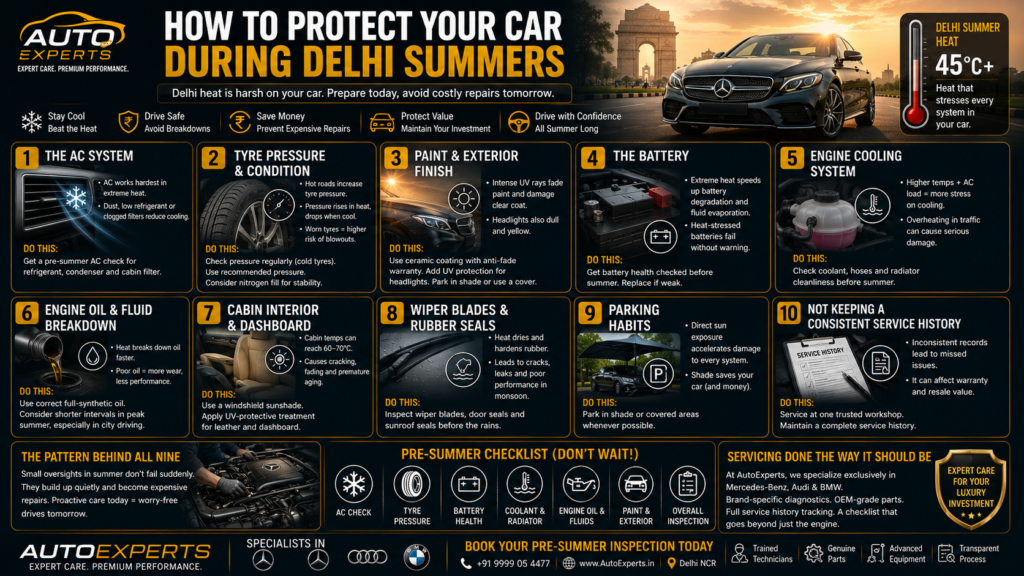
How to Protect Your Car During Delhi Summers
Delhi summers don’t ease in gradually — by April, temperatures are already pushing past 40°C, and by June, the tarmac itself becomes a heat source, radiating warmth back up into the car long after the sun has technically moved on. For a luxury vehicle, this isn’t just uncomfortable, it’s a genuine stress test across nearly every system: the AC, the tyres, the paint, the battery, and the cabin all take a harder hit than they would in a milder climate.
Here’s a system-by-system look at what Delhi’s summer actually does to your car, and what you can do about each one before the heat catches you off guard.
1. The AC System
Delhi’s heat pushes AC systems to their absolute limit, and any existing weakness — low refrigerant, a dusty condenser, a clogged filter — that felt unnoticeable in winter becomes obvious the moment summer arrives.
What to do: Get a pre-summer AC health check that covers refrigerant levels, condenser cleanliness, and cabin filter condition — ideally before peak heat hits, not after you’re already sitting in a warm car during a traffic jam. If your AC felt sufficient a few months ago and feels weaker now, that’s a sign of an underlying issue, not just “the heat.”
2. Tyre Pressure and Condition
Hot tarmac and sustained highway speeds cause tyres to heat up significantly, and the air inside expands as a result. Combined with Delhi’s daytime heat baking the tyre from outside as well, pressure can rise well above your usual setting during a summer drive — and drop again once temperatures fall in the evening.
What to do: Check tyre pressure more frequently in summer than you would the rest of the year, ideally when tyres are cool (first thing in the morning, before driving). Avoid over-inflating to compensate for expected heat gain — set to the manufacturer-specified cold pressure and let the heat do the rest. If you haven’t already, nitrogen fill helps reduce the size of these swings, since it’s less affected by heat-driven expansion than regular air.
3. Paint and Exterior Finish
UV exposure in Delhi summers is intense and sustained, and it’s the single biggest factor behind paint fading, dulling, and clear coat degradation over time. Headlights take a similar hit, since their protective UV coating breaks down under the same conditions.
What to do: A ceramic coating with a proper anti-fade guarantee is the most direct way to protect paint through summer, and it’s worth extending that same UV protection to your headlights specifically, since they’re often left out even when the paint is coated. Parking in shade or using a car cover during peak hours also meaningfully slows this degradation over the season.
4. The Battery
It’s a common misconception that batteries only struggle in cold weather — in reality, extreme heat is harder on a car battery than cold, because high temperatures accelerate the internal chemical reactions that cause a battery to degrade, and speed up fluid evaporation inside it.
What to do: Have your battery’s health checked before summer rather than waiting for it to fail — batteries often show reduced capacity gradually before they fail outright, and a heat-stressed battery is more likely to give out with little warning, often at the worst possible moment (like a hot afternoon with the AC running at full load).
5. Engine Cooling System
Between higher ambient temperatures and increased AC load, your engine’s cooling system works considerably harder through a Delhi summer than the rest of the year, especially during long idling in traffic when there’s little airflow to help.
What to do: Have coolant levels, hose condition, and radiator cleanliness checked before summer — a coolant that’s overdue or a radiator partially clogged with road dust and debris reduces cooling efficiency exactly when the system needs it most. If you notice the temperature gauge running higher than usual, especially in traffic, don’t wait for the next scheduled service to have it looked at.
6. Engine Oil and Fluid Breakdown
Heat accelerates oil breakdown, and Delhi’s summer combination of high ambient temperature, traffic idling, and AC load means oil works harder and degrades faster than it would in milder months.
What to do: If your driving is mostly summer city traffic, consider shifting to the shorter end of your service interval during peak heat months, and make sure you’re using the correct full-synthetic spec for your engine — a lower-grade oil is even more likely to break down prematurely under Delhi’s summer conditions.
7. Cabin Interior and Dashboard
Prolonged heat and UV exposure inside a parked car — which in Delhi summer can easily reach 60-70°C inside a closed cabin — takes a toll on leather, dashboard materials, and interior trim over time, causing cracking, fading, and premature aging of surfaces.
What to do: Use a windshield sunshade when parking outdoors for extended periods, and consider a UV-protective treatment for leather seats and dashboard surfaces. Cracking windshield sunshade use also has a practical side benefit: it keeps the cabin meaningfully cooler, reducing the initial load on your AC when you start driving.
8. Wiper Blades and Rubber Seals
It’s easy to forget wiper blades in summer since they’re associated with monsoon use, but constant heat exposure dries out and hardens rubber components — wiper blades, door seals, and sunroof seals — even when they’re not being actively used.
What to do: Inspect wiper blades and rubber seals before monsoon season arrives (which follows shortly after peak summer in Delhi). A seal that’s hardened from months of summer heat is exactly the kind of thing that fails to keep water out once the rains start.
9. Parking Habits
Where and how you park during summer has a bigger cumulative effect than most owners realize — direct sun exposure for hours daily accelerates nearly every issue on this list, from paint fading to battery stress to interior cracking.
What to do: Prioritize shaded or covered parking whenever available, even if it means walking a bit further. Over an entire summer, the difference in cumulative heat exposure between a shaded spot and direct sun is substantial.
Why This Matters More for Luxury Vehicles
Mercedes-Benz, Audi, and BMW vehicles tend to have more integrated, sensor-driven systems — multi-zone climate control, adaptive LED headlights, advanced engine cooling management — all of which are more sensitive to being pushed toward their limits than simpler, older systems. A stressed component on these platforms tends to show up as a broader performance issue rather than an isolated one, since so many systems are designed to work together.
A Pre-Summer Checklist Beats a Mid-Summer Breakdown
The theme across all nine of these is the same: nothing on this list fails suddenly. Every one of them builds gradually across the season, which means there’s a real window — ideally before peak summer sets in — where a proactive check catches small issues before Delhi’s heat turns them into bigger ones.
Get Ahead of Delhi’s Summer, Not Behind It
At AutoExperts, our pre-summer inspection covers exactly the systems Delhi’s heat stresses most — AC, cooling system, battery, tyres, and paint protection — so you’re not finding out what needs attention in the middle of a 43°C afternoon.
Book a pre-summer inspection with us today, and drive through the season with confidence instead of crossed fingers.