




PPF vs Ceramic Coating: Which Paint Protection Is Right for Your Luxury Car?
Walk into any detailing shop with a luxury car and you’ll likely hear both pitched to you — PPF (Paint Protection Film) and ceramic coating. They’re often mentioned in the same breath, which leads a lot of owners to assume they do the same job, or that you need both to properly protect your car. Neither is quite true.
They protect against different things, in different ways, at very different price points. Understanding what each one actually does — and doesn’t do — will save you from overspending on protection you don’t need.
What Ceramic Coating Actually Does
Ceramic coating is a liquid polymer applied to your car’s paint that chemically bonds with the clear coat, forming a hard, glossy, protective layer on the surface.
What it protects against:
- UV rays and fading: This is ceramic coating’s core strength. It shields the paint from UV exposure, which is what causes paint to oxidize, dull, and fade over time — a real concern for Delhi’s intense summer sun.
- Chemical stains: Bird droppings, tree sap, road grime, and mild acidic contaminants are far less likely to etch into the paint, since the coating creates a barrier between contaminants and the clear coat.
- Water and dirt: Ceramic coating is hydrophobic, meaning water beads and rolls off rather than sitting on the surface, taking dirt and grime with it. This makes the car noticeably easier to keep clean.
- Gloss and depth: Most owners notice an immediate visual difference — a deeper, glossier finish that’s easier to maintain over the following years.
What it does not protect against:
- Scratches and stone chips: Ceramic coating is a thin, hard layer — it does not add meaningful thickness or cushioning to absorb an impact. A key scratch, a shopping cart bump, or a stone chip on the highway will still damage the paint underneath.
- Dents: Ceramic coating has zero impact on dent resistance, since it doesn’t change the metal or the paint’s flexibility in any structural sense.
Typical lifespan: 2-5 years depending on the product grade and maintenance, after which it can be reapplied.
What PPF Actually Does
PPF is a thick, transparent urethane film physically applied to the car’s body panels, essentially acting as a sacrificial layer between the road and your actual paint.
What it protects against:
- Stone chips and road debris: This is what PPF was originally built for. Highway driving kicks up gravel and debris that can chip paint on the front bumper, hood, and mirrors — PPF absorbs that impact instead of the paint.
- Light scratches: Many modern PPF products are “self-healing,” meaning small surface scratches (from car washes, branches, or light contact) disappear on their own with a bit of heat, since the film’s top layer can flex back into shape.
- Some chemical and UV exposure: Quality PPF also has UV-resistant properties, though this is a secondary benefit rather than its main purpose.
What it does not protect against:
- Dents: This is the most misunderstood point about PPF, and it’s important to be clear about it: PPF is a thin protective film, not a structural layer. It does nothing to prevent denting from a door ding, hailstorm, or parking lot bump. If you’re specifically worried about dents, PPF will not solve that problem — no film-based product will, since dent resistance comes down to the metal panel itself, not what’s coated on top of it.
- Gloss enhancement on its own: PPF is designed to be nearly invisible, not to add shine. Most owners pair it with a ceramic top-coat specifically for the finish, which is where some of the “you need both” confusion comes from.
Typical lifespan: 5-10 years depending on the film quality, after which it can show yellowing or lifting at the edges and typically needs replacement.
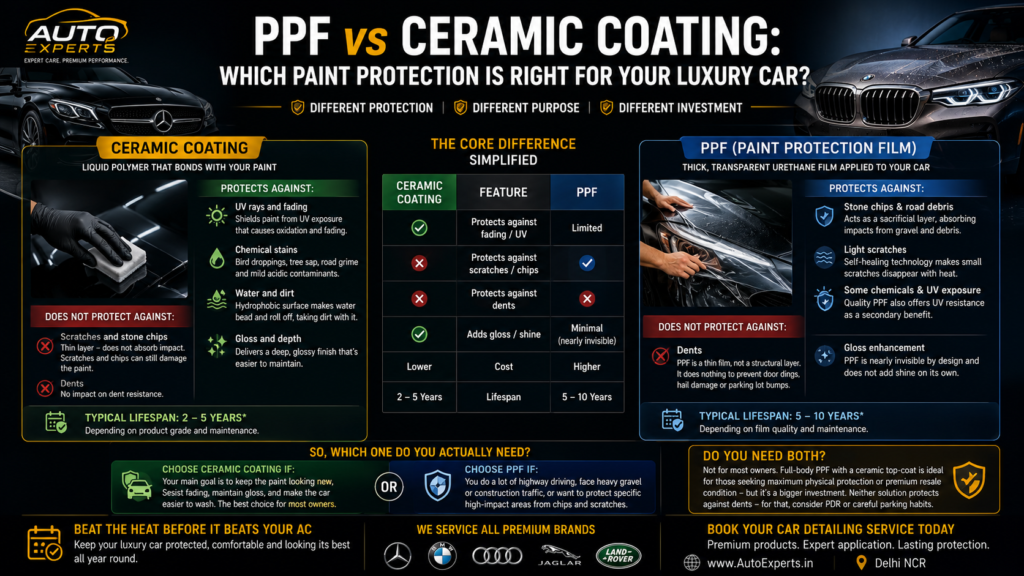
The Core Difference, Simplified
| Ceramic Coating | PPF | |
| Protects against fading/UV | Yes — its main strength | Limited |
| Protects against scratches/chips | No | Yes — its main strength |
| Protects against dents | No | No |
| Adds gloss/shine | Yes | Minimal (nearly invisible) |
| Cost | Lower | Higher |
| Lifespan | 2-5 years | 5-10 years |
The honest way to think about it: ceramic coating protects the paint’s appearance, PPF protects the paint’s surface from physical damage. They solve different problems — one isn’t an upgraded version of the other.
So Which One Do You Actually Need?
Choose ceramic coating if: Your main concern is keeping the paint looking new — resisting fading, maintaining gloss, and making the car easier to wash. This covers the vast majority of what actually affects a car’s paint condition over normal ownership, especially in a sun-heavy, dusty climate like Delhi’s.
Choose PPF if: You do a lot of highway driving, live somewhere with heavy gravel or construction traffic, or you’re protecting a specific high-risk area — the front bumper, hood, and mirrors are the most common candidates — from chips and scratches.
Do You Need Both?
For most owners, no — and this is worth saying plainly, because it’s often oversold as a package deal. If your primary concern is your paint staying vibrant and not fading under the sun, a quality ceramic coating with a proper fade/gloss guarantee covers that on its own, and it’s the more cost-effective choice.
Full-body PPF combined with a ceramic top-coat makes sense for a specific kind of owner — someone doing significant highway driving, protecting a car they plan to resell at premium condition, or simply wanting maximum physical protection regardless of cost. But it’s a meaningfully bigger investment, and it’s solving a different problem (chip and scratch prevention) than what most owners are actually worried about (fading and dullness).
One thing worth being clear-eyed about either way: neither product protects against dents. If dent protection is genuinely your priority — say, you park in a tight, high-traffic area — that’s a separate conversation about parking habits or dent-guard accessories, not something PPF or ceramic coating will solve, despite how they’re sometimes marketed.
Our Recommendation
If you’re deciding between the two, start with what’s actually bothering you about your paint. If it’s fading, dulling, or losing that fresh-off-the-showroom gloss — ceramic coating, backed by a proper anti-fade guarantee, solves that directly and cost-effectively, without the need to also invest in PPF. Save PPF for when physical chip and scratch protection is a genuine, specific concern — not as a default “more protection is always better” add-on.
Not Sure Which Fits Your Car?
At AutoExperts, we walk you through what your car actually needs based on how you drive it — not a one-size-fits-all package. If fading and gloss are your main concern, we’ll set you up with a ceramic coating backed by a clear anti-fade guarantee, without pushing PPF you don’t need.
Book a paint protection consultation with us, and get the option that actually matches your car’s real risks.
What Happens If You Delay Scheduled Maintenance?
“I’ll get it done next month” is one of the most common — and most expensive — sentences in car ownership. A scheduled service gets pushed back a few weeks, then a few months, and nothing seems to go wrong. The car still drives fine. So it feels like a safe decision.
The problem is that scheduled maintenance isn’t reactive — it’s preventive. It’s built around catching wear before it turns into failure, which means the consequences of delaying it are often invisible right up until they aren’t. For Mercedes-Benz, Audi, and BMW vehicles specifically, where systems are tightly interconnected, a small delay in one area tends to put strain on several others at once.
Here’s what’s actually happening under the hood when a scheduled service gets pushed back — and why “it still drives fine” isn’t the same as “it’s fine.”
1. Oil Breaks Down and Stops Protecting the Engine
Engine oil has a functional lifespan, not just a mileage number. Past a certain point, it loses viscosity, picks up contaminants, and stops lubricating properly — regardless of how smooth the engine still sounds.
What delay actually does: Degraded oil means increased friction between moving engine parts, which accelerates wear on components that are expensive to access and replace — particularly on turbocharged engines, where the turbo relies on clean, properly flowing oil for both lubrication and cooling.
The compounding effect: The engine doesn’t announce this wear in real time. It shows up months later as reduced performance, increased oil consumption, or in more serious cases, turbo damage — at which point you’re paying for a component failure instead of a $150-200 oil service.
2. Small Fluid Leaks Go Undetected
A scheduled service isn’t just an oil change — it typically includes a visual inspection of hoses, seals, and fluid levels across the engine, transmission, brakes, and cooling system. This is often the only point where a slow, early-stage leak actually gets noticed, since these leaks are usually too gradual to spot from the driver’s seat.
What delay actually does: A minor coolant or transmission fluid leak that would’ve been caught and fixed cheaply during a routine check instead continues slowly, unnoticed, for months.
The compounding effect: By the time a slow leak becomes visible — a puddle under the car, a warning light, or a temperature spike — the fluid level has often already dropped enough to cause secondary damage, like an overheating engine or a transmission running low on the fluid it needs to shift properly.
3. Brake Wear Progresses Past the Safe Replacement Window
Brake pads are designed to wear down and be replaced before they reach the rotor. Scheduled inspections catch pad thickness at a stage where replacement is simple and rotors stay untouched.
What delay actually does: Skip that inspection window, and pads can wear down to the point where metal backing plates start contacting the rotor directly — turning a pad replacement into a pad-and-rotor replacement, since scored rotors typically can’t be reused.
The compounding effect: Beyond the added cost, this is also the one item on this list with a direct safety dimension — worn brakes mean longer stopping distances, which is a risk that grows quietly until the moment you actually need to stop quickly.
4. Filters Clog, and the Systems Behind Them Work Harder
Air filters, cabin filters, and fuel filters all have a similar story: they’re inexpensive on their own, but they protect more expensive components downstream.
What delay actually does: A clogged air filter forces the engine to work harder to draw in air, slightly reducing efficiency and increasing strain over time. A clogged cabin filter reduces AC performance and forces the blower motor to work harder. A neglected fuel filter can allow more contaminants toward the fuel injectors — precision components that are considerably more expensive to clean or replace than the filter protecting them.
The compounding effect: None of these failures happen suddenly. They show up as a gradual dip in performance that’s easy to attribute to “the car getting older” rather than a specific, fixable cause — until the component behind the filter is the one that finally fails.
5. Minor Software and Sensor Issues Go Unaddressed
Modern luxury vehicles run frequent software updates and diagnostic checks as part of scheduled servicing — calibrating sensors, updating control modules, and catching early fault codes that haven’t yet triggered a dashboard warning light.
What delay actually does: Skipping these checks means small sensor drift or outdated software calibrations go uncorrected, which can affect everything from fuel efficiency to transmission shift smoothness to how accurately safety systems respond.
The compounding effect: These issues rarely feel urgent individually, but they accumulate — a car that’s due for three or four small updates tends to feel noticeably less refined to drive than one kept current, even if no single issue is dramatic on its own.
6. Manufacturer Warranty Coverage Can Be Affected
Most manufacturer warranties are conditional on maintaining the specified service schedule. This is often the most overlooked consequence of delayed maintenance, because it doesn’t show up as a mechanical problem — it shows up as a claim denial.
What delay actually does: If a major component fails and the service history shows a lapsed or skipped maintenance interval, the manufacturer or extended warranty provider may have grounds to deny the claim, arguing the failure was linked to inadequate maintenance rather than a manufacturing defect.
The compounding effect: This turns what should have been a warranty-covered repair into a full out-of-pocket expense — often for exactly the kind of major component failure that scheduled maintenance was designed to prevent in the first place.
Why the Cost Gap Widens the Longer You Wait
The theme across all six of these is the same: scheduled maintenance is cheap specifically because it catches things early. Every item on this list — oil, fluids, brakes, filters, software, warranty terms — has a version of the same story: caught on schedule, it’s a routine, inexpensive fix. Caught late, it’s a component replacement, a safety risk, or an out-of-pocket bill that used to be covered.
This gap tends to be wider on luxury vehicles specifically, because the components involved are engineered to tighter tolerances and cost more to replace — a turbo, a mechatronic transmission unit, or a set of scored rotors on a Mercedes, Audi, or BMW carries a meaningfully higher price tag than the equivalent part on a mainstream vehicle.
A Delayed Service Rarely Announces Itself
Perhaps the most important thing to understand is that delaying maintenance almost never feels risky in the moment. The car keeps starting, keeps driving, keeps getting you where you need to go — right up until the point where it doesn’t. That gap between “feels fine” and “is fine” is exactly the space scheduled maintenance is designed to close.
Back on Schedule, Without the Guesswork
If you’ve fallen behind on your service schedule — whether by a few weeks or a few months — the best move isn’t to wait for the next milestone, it’s to get a full inspection now and reset the schedule from an accurate starting point.
At AutoExperts, we’ll check exactly where your car stands, flag anything that’s moved from “routine” to “urgent” during the delay, and get you back on a schedule that protects both your car and your warranty. Book your service with us today — the earlier we catch it, the less it costs to fix.