






Delhi summers don’t leave much room for a weak AC. When temperatures push past 40°C and the tarmac is radiating heat back into the cabin, a car that “cools eventually” isn’t good enough — and if your AC has been working harder than usual to get there, it’s telling you something.
Delhi’s climate is uniquely hard on car AC systems. Extreme heat, dust, heavy traffic, and long idling hours during peak summer all combine to stress a system that was already working near its limits. Here’s why your AC might be underperforming, and what’s actually behind it.
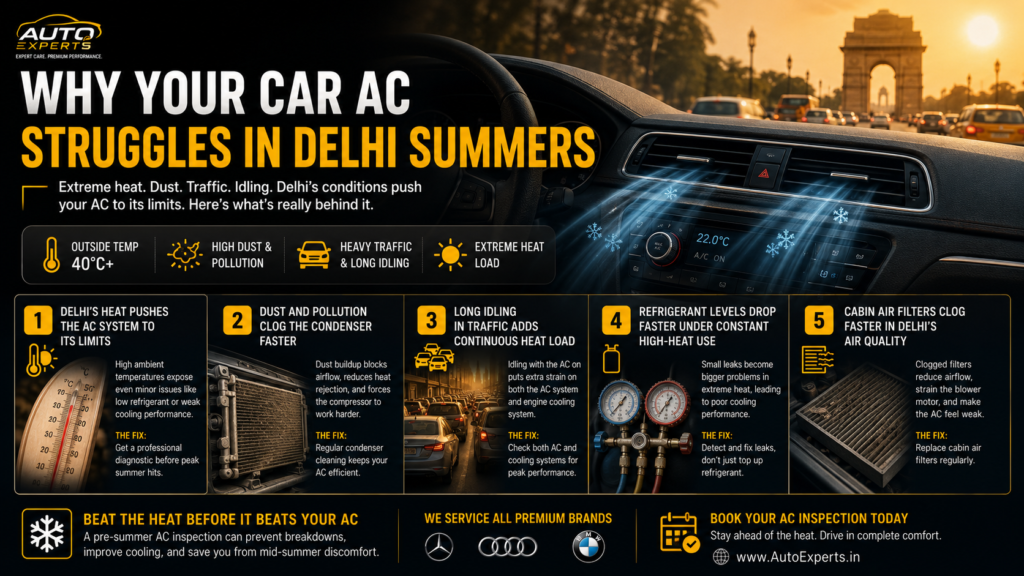
1. Delhi’s Heat Pushes the AC System to Its Limits
Every car AC system is designed to cool air by a certain number of degrees below ambient temperature — not to hit a fixed target regardless of outside heat. When it’s 44°C outside, the system has significantly more heat to remove than it does on a mild day, which means any existing weakness in the system — even one you wouldn’t notice in winter — becomes obvious in peak summer.
What this means: An AC system that’s slightly low on refrigerant or has a partially clogged condenser might feel “fine” for most of the year and then suddenly feel inadequate the moment Delhi’s summer heat arrives. It’s not that the AC got worse overnight — the heat has just exposed an existing issue.
The fix: If your AC felt sufficient in March but weak by May, that’s a strong sign of an underlying issue rather than “just the heat” — worth a proper diagnostic check rather than assuming it’ll be fine once summer ends.
2. Dust and Pollution Clog the Condenser Faster
Delhi’s air quality is a genuine mechanical problem for your AC, not just a health one. The condenser — the component at the front of your car that releases heat from the refrigerant — sits directly in the path of incoming air, which means it also collects road dust, pollen, and the fine particulate matter Delhi is known for.
What this means: A condenser coated in dust can’t release heat efficiently, which forces the compressor to work harder and raises system pressure — reducing cooling performance and putting extra strain on the compressor over time.
The fix: In Delhi’s conditions, condenser cleaning deserves a spot on your regular service checklist, not just an occasional deep clean. If your AC has been gradually getting weaker over weeks, a clogged condenser is one of the first things worth ruling out.
3. Long Idling in Traffic Adds Continuous Heat Load
Delhi traffic means long stretches of idling — at signals, in jams, in parking queues — often with the AC running the entire time and very little airflow moving through the engine bay to help cool things down. This is a genuinely tougher condition for an AC and cooling system than steady highway driving, where airflow does a lot of the cooling work for free.
What this means: During long idling, the AC compressor and the engine’s cooling system are both working near their limits simultaneously, with less help from moving air. If either system has any underlying weakness, heavy Delhi traffic is exactly the condition that will expose it — often showing up as warm air blowing intermittently or the AC struggling more in traffic than while driving.
The fix: If your AC noticeably weakens specifically during traffic or idling (rather than while driving), it’s worth having both the AC system and the engine cooling system checked together, since the two are closely linked under these conditions.
4. Refrigerant Levels Drop Faster Under Constant High-Heat Use
AC systems don’t consume refrigerant under normal operation — but small leaks that would be barely noticeable in a mild climate become more apparent when the system is running at near-maximum output for months at a stretch, as it does through a Delhi summer.
What this means: A slow leak from a worn seal or hose might lose refrigerant slowly enough that it’s not noticeable in cooler months, but by peak summer — after the system has been running hard for weeks — the refrigerant level can drop enough to cause a real, noticeable dip in cooling performance.
The fix: If cooling performance has dropped gradually over the course of the summer rather than suddenly, a refrigerant leak test is the most direct way to find out. Simply topping up refrigerant without finding the leak is a short-term fix — it’ll drop again.
5. Cabin Air Filters Clog Faster in Delhi’s Air Quality
The cabin air filter controls how much air reaches your blower and vents, and Delhi’s dust and particulate levels mean this filter clogs meaningfully faster here than it would in a cleaner-air city.
What this means: A clogged filter restricts airflow, so even a perfectly healthy AC system will feel weaker simply because less cooled air is making it into the cabin — and it also forces the blower motor to work harder than it should.
The fix: In Delhi, cabin air filters are worth checking every service visit rather than sticking strictly to the standard interval — it’s a low-cost part that has an outsized effect on how cold the cabin actually feels.
Why This Matters More for Luxury Vehicles Specifically
Mercedes-Benz, Audi, and BMW AC systems are more tightly integrated with the car’s overall climate control computer than older or simpler systems — many use multi-zone climate control that constantly balances vent temperature, airflow, and cabin sensors to hit a set target. This makes them more precise in normal conditions, but it also means any single weak point — a dusty condenser, a slow leak, a clogged filter — throws off the whole calculation, often showing up as inconsistent cooling rather than a simple “AC is weak” symptom.
Getting Ahead of Delhi Summer, Not Behind It
The pattern across all five of these causes is the same: none of them appear suddenly. They build up gradually — a bit more dust on the condenser each week, a slow leak losing a little more refrigerant each month, a filter getting a little more clogged each drive — until Delhi’s peak heat finally exposes the gap. That also means most of them are far cheaper to catch early than to fix once the compressor has been overworked for an entire summer.
Beat the Heat Before It Beats Your AC
At AutoExperts, we see this pattern every summer — AC systems that were “fine” in February and struggling by May. A pre-summer AC health check covers exactly the areas Delhi’s climate stresses most: condenser cleanliness, refrigerant levels, filter condition, and compressor performance under load.
Book an AC inspection with us today, and stay ahead of the heat instead of finding out the hard way at 2 PM in July traffic.