






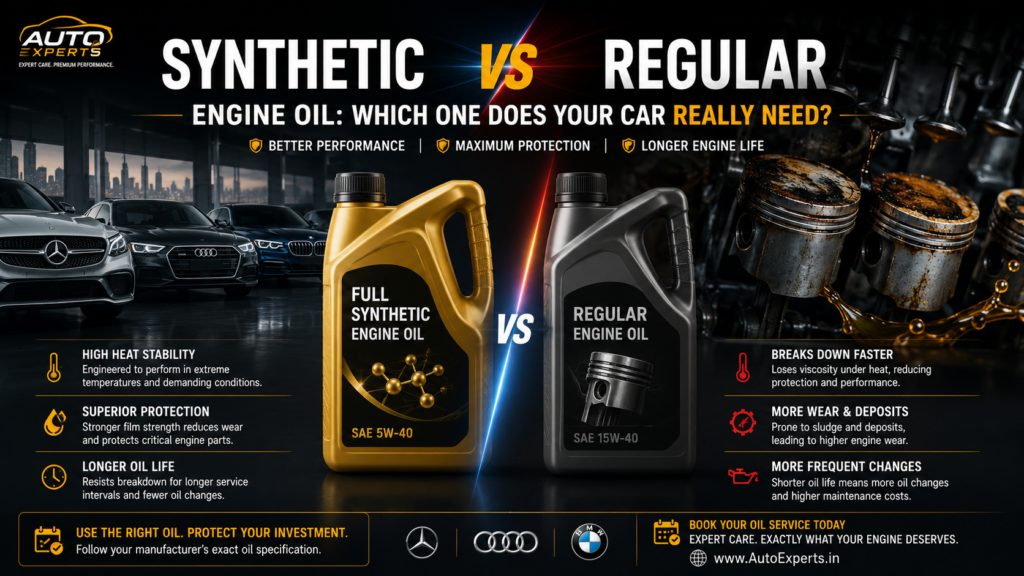
Synthetic vs Regular Engine Oil: Which One Does Your Car Really Need?
Walk into any auto parts store and you’ll find a wall of oil bottles — synthetic, semi-synthetic, conventional, high-mileage, each promising something different. For most drivers, this decision gets made in about ten seconds, usually based on price. But for luxury vehicles like Mercedes-Benz, Audi, and BMW, the type of oil you use isn’t just a maintenance preference — it directly affects engine performance, longevity, and in many cases, your warranty.
Here’s what actually separates synthetic from conventional oil, and which one your car is genuinely built for.
What’s the Actual Difference?
Conventional oil is refined directly from crude oil. It’s been the industry standard for decades and works fine for older, simpler engines with looser tolerances. It’s cheaper, but it breaks down faster under heat and stress, and it leaves more deposits behind over time.
Synthetic oil is chemically engineered rather than simply refined. Manufacturers build the oil molecules to a consistent size and structure, which means it flows more evenly, resists breaking down at high temperatures, and keeps its protective properties for far longer.
Semi-synthetic (or “synthetic blend”) oil sits in between — a mix of conventional and synthetic oil that offers some of the benefits of full synthetic at a lower price point, though with less of the performance upside.
The short version: synthetic oil is a more refined, more consistent product designed to handle more demanding conditions. And “demanding conditions” describes exactly what luxury performance engines are built for.
Why This Matters More for Mercedes, Audi, and BMW Owners
1. Turbocharged Engines Run Hotter
Most modern Mercedes, Audi, and BMW engines are turbocharged, which means they generate significantly more heat than a naturally aspirated engine. Turbochargers spin at extremely high speeds and rely on oil for both lubrication and cooling. Conventional oil breaks down faster under this kind of heat, losing its ability to protect the turbo’s bearings — which are some of the most expensive components to replace if they fail.
Solution: Full synthetic oil handles high heat without breaking down, protecting the turbo and keeping oil pressure consistent even during hard driving or hot weather.
2. Tighter Engine Tolerances Need Consistent Flow
Luxury performance engines are built with tighter tolerances between moving parts than most mainstream engines. That precision is part of what makes them powerful and efficient — but it also means the oil needs to flow evenly and consistently to properly lubricate every surface, especially during cold starts when oil is at its thickest.
Solution: Synthetic oil maintains a more stable viscosity across temperature extremes, so it flows properly on a cold morning start and stays protective once the engine is at full operating temperature.
3. Manufacturer Specifications Often Require It
This is the part many owners don’t realize: most Mercedes-Benz, Audi, and BMW models are engineered to run specific manufacturer-approved oil specifications (like BMW LL-01, Mercedes MB 229.5, or Audi/VW 502.00) — and these specs are built around full synthetic oil, not conventional.
Solution: Using an oil that doesn’t meet your car’s required specification — even if it’s technically “synthetic” — can affect performance and, in some cases, void warranty coverage. Always check your owner’s manual or ask your service center to confirm the exact spec your engine calls for.
4. Longer Intervals Between Changes
Synthetic oil breaks down more slowly, which is why many synthetic-oil vehicles have extended service intervals compared to conventional oil (often 7,500–10,000 miles versus 3,000–5,000 for conventional). If you’re still changing your oil every 3,000 miles “just to be safe,” you may be spending more than necessary without any added benefit.
Solution: Follow the interval specified for your exact model and driving conditions — frequent short trips, towing, or hot climates can shorten that interval, so it’s worth confirming with your service advisor rather than guessing.
So Which One Does Your Car Actually Need?
For the vast majority of Mercedes-Benz, Audi, and BMW models on the road today, the answer is straightforward: full synthetic oil, matching your manufacturer’s exact specification. These engines were designed around synthetic oil’s properties from the start, and running conventional oil — even temporarily — can mean faster wear on the turbo, timing components, and internal engine surfaces.
The only real exceptions are older, pre-turbo models where the manufacturer originally specified conventional oil. Even then, most technicians will recommend upgrading to synthetic, since it offers better protection with no real downside beyond a modestly higher price per oil change.
The Cost of Getting It Wrong
Using the wrong oil rarely causes an immediate, obvious problem — that’s what makes it risky. The effects show up gradually: slightly faster wear on the turbo, more carbon buildup, oil that breaks down before your next scheduled change. By the time it becomes a noticeable issue, you’re often looking at a repair bill far larger than the difference in oil cost would have ever added up to.
The reverse is also true. Consistently using the correct synthetic oil, on the correct schedule, is one of the simplest and cheapest things you can do to protect a high-value engine over the long run.
Not Sure What Your Car Needs? We’ll Check.
Oil specifications vary not just by brand, but by model year and engine type — the right oil for a 2019 BMW 3 Series isn’t necessarily the right oil for a 2023 X5. Rather than guessing from a bottle label, it’s worth having a technician confirm the exact spec your vehicle requires.
At AutoExperts, every oil change is matched to your exact manufacturer specification — no shortcuts, no generic blends. Book your next oil service with us and drive with the confidence that your engine is getting exactly what it was built for.